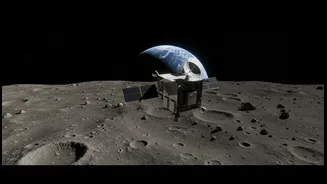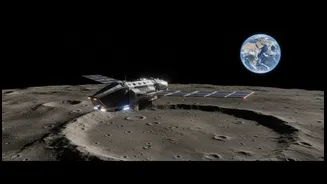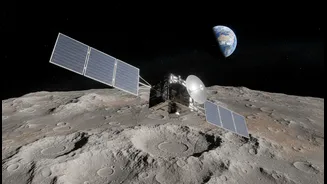



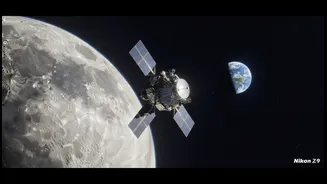


What is CAPSTONE?
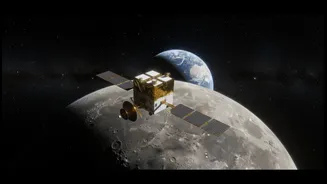
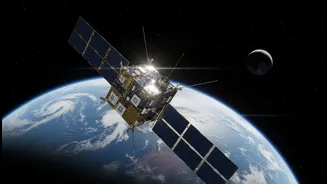
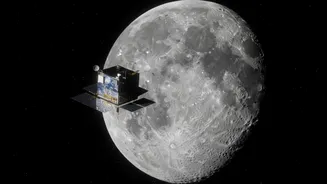
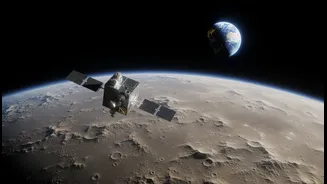
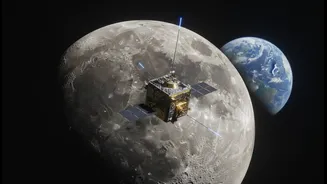
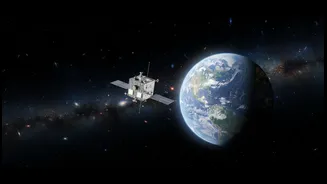
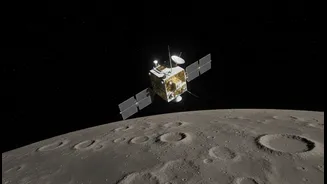
CAPSTONE, short for Cislunar Autonomous Positioning System Technology Operations and Navigation Experiment, is a microwave-oven-sized satellite with a monumental task. Launched in June 2022, its primary job was to test a unique, fuel-efficient orbit around
the Moon called a near rectilinear halo orbit (NRHO). This is the same orbit planned for the Gateway, an upcoming lunar space station that will support NASA's Artemis missions. The small satellite, owned and operated by the company Advanced Space, successfully entered this orbit in November 2022. After completing its primary objectives, NASA's official activities with the spacecraft concluded in June 2026, but the spacecraft continues to operate as a testbed for new technologies.
The Challenge of Finding Your Way
On Earth, we take GPS for granted. In cislunar space—the region around the Moon—there is no such system. For decades, spacecraft have relied on a constant connection with Earth-based antennas, like NASA's Deep Space Network (DSN), to determine their location. This process is slow, expensive, and creates a significant bottleneck. The DSN is already oversubscribed, and with hundreds of government and commercial lunar missions planned, relying on Earth for every positional 'ping' is simply not sustainable. For a permanent lunar presence with multiple spacecraft, landers, and rovers operating simultaneously, a new, more independent method of navigation is essential.
A Lunar 'Handshake' for Navigation
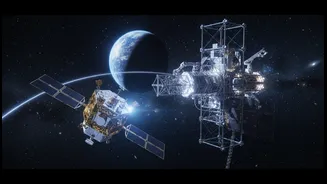
This is where CAPSTONE's groundbreaking experiment comes in. The mission is demonstrating the Cislunar Autonomous Positioning System (CAPS), a technology designed to allow spacecraft to find their own position without constantly calling home. It works by performing a kind of digital handshake with another spacecraft. CAPSTONE communicates directly with NASA's Lunar Reconnaissance Orbiter (LRO), which has been circling the Moon since 2009. By measuring the distance and rate of change between itself and LRO, CAPSTONE’s onboard software can calculate its own position in space. This peer-to-peer system is the first step toward creating a 'GPS' for the Moon, allowing spacecraft to navigate autonomously.
Why Autonomous Navigation Matters
Proving this technology works has massive implications. Autonomous navigation makes future missions more efficient, resilient, and affordable. Spacecraft can operate safely even when out of contact with Earth, such as on the far side of the Moon. It reduces the strain on the Deep Space Network, freeing up bandwidth for more critical scientific data or deep space missions to other planets. For complex operations like rendezvous, docking, or landing, the ability to make real-time positioning calculations without Earth-based delays is a crucial safety and performance enhancement. It is a foundational technology required for building a sustainable lunar economy, from commercial landers to long-term robotic and human outposts.
Paving the Way for a Busy Moon
The success of CAPSTONE is more than just a technical achievement; it's a paradigm shift. Its extended mission has served as a flexible testbed for a variety of software and communication technologies, proving that small, relatively inexpensive CubeSats can perform high-stakes work in deep space. As nations like India continue to advance their own impressive lunar ambitions with the Chandrayaan program, the technologies proven by CAPSTONE offer a blueprint for future collaboration and interoperability. The ability for different spacecraft from different agencies and companies to share positioning data will be essential in the increasingly busy and collaborative environment around the Moon, ensuring that exploration can proceed safely and sustainably for everyone.