







The Dangers of Lunar Dust
The soil on the Moon, known as regolith, is not like the soil on Earth. Billions of years of micrometeorite impacts have pulverised the rock into a fine powder of tiny, sharp, and abrasive particles. Because there is no wind or water to erode their edges,
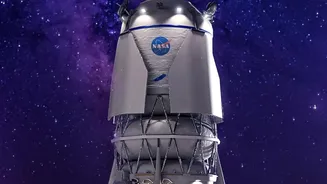
these particles are like microscopic shards of glass. During the Apollo missions, astronauts found that this dust was a major nuisance. It was electrostatically charged, causing it to cling to everything from spacesuits to equipment. Apollo astronauts reported symptoms like hay fever, sneezing, and watery eyes from the dust that made its way into their lunar module. Beyond being a health hazard, the dust poses a significant risk to technology. When a lander's powerful engines fire near the surface, they can kick up a high-velocity spray of this abrasive regolith, sandblasting and damaging nearby hardware, solar panels, and future habitats.
Paving the Way with Local Material
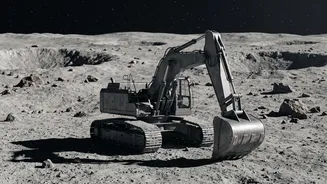
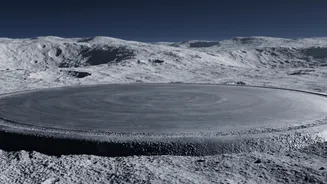
The solution to this destructive dust could lie within the dust itself. The concept is a cornerstone of modern space exploration strategy known as 'in-situ resource utilization', or ISRU. Put simply, it means using what you find locally to build what you need. Transporting materials from Earth to the Moon is incredibly expensive and logistically complex, so the ability to use the abundant lunar regolith as a construction material is a game-changer. Researchers are actively developing methods to turn the loose, powdery regolith into solid, durable surfaces for landing pads, roads, and even protective barriers for habitats. A solid landing pad would prevent the engine plume from kicking up dust, dramatically increasing the safety and longevity of lunar missions and equipment.
How to Build a Moon Pad
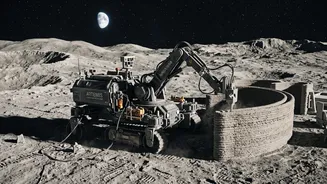
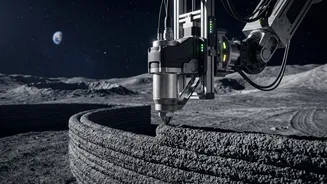
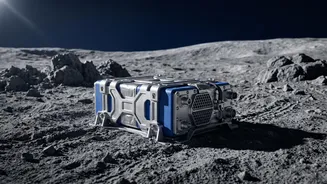
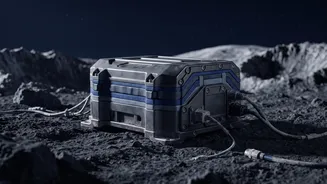
Several promising techniques are being explored to transform regolith into a construction-grade material. One of the leading methods is called sintering, which involves heating a material until its particles fuse together without fully melting. Researchers are testing ways to do this using concentrated solar energy or powerful microwaves. One project involves using magnetic fields to separate metallic particles within the regolith, which can then be efficiently heated by microwaves to melt the surrounding soil into a strong, ceramic-like solid. Other approaches involve 3D printing, where robotic systems equipped with high-powered lasers could melt the regolith layer by layer to build up structures. The goal is to create a process that can be largely automated by robots, using solar panels for power, to prepare a safe landing zone before astronauts even arrive.
From Science Fiction to Feasible Project
This technology is moving rapidly from theory to practice. Research teams funded by agencies like NASA and the European Space Agency are conducting experiments using lunar regolith simulant—a material created on Earth to mimic the properties of moon dust. These tests have successfully produced small, solid pucks and tiles that demonstrate the strength of sintered regolith. For example, one test showed that a tile made from sintered simulant was stronger than some types of concrete. Companies like ICON, which has experience 3D-printing homes on Earth, have received NASA funding to develop robotic construction systems for the Moon. These efforts are part of NASA's broader plan to establish the infrastructure needed for a long-term human presence, including the Artemis program, which aims to build a sustainable base at the lunar South Pole.