
Sailing on Sunlight
The concept of a solar sail sounds like science fiction, but it's grounded in real physics. Imagine a massive, ultra-thin mirror, often as large as a small apartment, attached to a spacecraft. This is the solar sail. Instead of wind, it catches sunlight.
Light is made of particles called photons, which have no mass but carry momentum. When these photons bounce off the reflective sail, they transfer a tiny amount of that momentum, giving the spacecraft a gentle but continuous push. Over time, in the frictionless vacuum of space, this constant pressure can accelerate the craft to incredible speeds without using a single drop of conventional fuel.
The Challenge of Steering
For years, while solar sails proved effective for propulsion, precise steering was a major hurdle. Getting a spacecraft to travel in a straight line was one thing, but getting it to perform delicate maneuvers, like entering orbit around a small object, was extremely difficult. The force from photon pressure is incredibly small—at Earth's distance from the sun, the force on a huge 800-by-800-meter sail is only about 5 newtons, roughly the weight of a small apple. Early missions often had to rely on traditional thrusters for fine-tuning, partially defeating the purpose of a propellant-less system. The key challenge was figuring out how to use this minuscule force for highly accurate navigation.
The Breakthrough: Precision Through Pressure
The latest breakthrough lies in a sophisticated new method of navigation. Scientists and engineers have developed advanced control systems and algorithms that allow a probe to minutely and continuously adjust the angle of its sail relative to the sun. By tilting different sections of the sail, the probe can control the direction of the reflected photons with unprecedented accuracy. This is analogous to a sailboat tacking against the wind. It allows the spacecraft to generate precise vectors of thrust, enabling it to spiral into stable, long-duration orbits around low-gravity objects like asteroids. This new technique effectively turns the solar sail from a simple engine into a precision rudder, using nothing but light.
A New Window on Near-Earth Asteroids
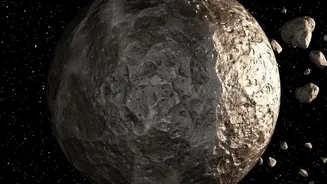
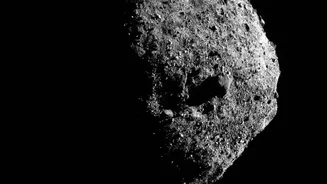
This new capability is a game-changer for exploring Near-Earth Asteroids (NEAs). NEAs are celestial bodies whose orbits bring them close to Earth. They are crucial to study for two main reasons: planetary defense and scientific discovery. Some NEAs are potentially hazardous, and understanding their size, shape, and composition is vital for assessing any threat they might pose. Using photon pressure navigation, a solar sail probe can now arrive at an asteroid and, instead of making a quick flyby, enter a close orbit for an extended period. This allows it to meticulously map the asteroid's surface in high resolution, study its geology, and search for resources like water ice, all without the mission lifetime limitations imposed by a finite fuel supply.
Beyond Mapping: Future Implications
The implications of this technology extend far beyond mapping a few asteroids. By eliminating the need for heavy propellant for maneuvering, missions can be made significantly lighter and therefore cheaper to launch. This could enable fleets of small, low-cost probes, like NASA's NEA Scout, to be deployed as a reconnaissance network, monitoring dozens of asteroids. Such a network would dramatically improve our planetary defense capabilities, providing early warnings and detailed data on any potential threats. Furthermore, the ability to loiter around and study asteroids for long periods is a critical stepping stone for future ambitions, including the potential for resource extraction and mining operations on these celestial bodies, turning them into resource depots for further exploration of the solar system.