




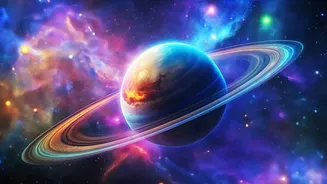

The Main Event: Saturn at Opposition
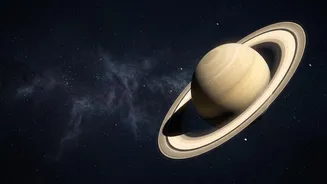
The most significant reason to watch Saturn this October is an event called opposition, which occurs on October 4, 2026. Opposition happens when Earth passes directly between the Sun and an outer planet, in this case, Saturn. This alignment places the ringed
planet opposite the Sun in our sky, meaning it rises in the east around sunset, climbs to its highest point around midnight, and sets in the west around sunrise. This makes it visible for the entire night, providing a generous window for observation. More importantly, during opposition, Saturn is at its closest point to Earth for the year, making it appear larger and brighter than at any other time. This combination of factors makes early October the absolute best time in 2026 to see the gas giant.
The Return of the Rings
What makes this particular opposition extra special is the view of Saturn's magnificent rings. During 2025, the rings were tilted edge-on to our line of sight, an event called a ring-plane crossing that happens only every 13 to 15 years. Because the rings are astonishingly thin—only about 30 feet thick in places—they virtually disappeared from view, even for many telescopes. But in October 2026, the rings are back. They will be tilted about 7 degrees towards Earth, revealing their southern face. While this is still a narrow angle compared to their maximum tilt, it means the rings will be clearly and easily visible again through a telescope, offering a beautiful, slender profile after a year of being hidden. This 're-opening' is a unique sight that won't be repeated for over a decade.
Finding the Ringed Planet
You don't need to be a seasoned astronomer to locate Saturn. This October, it will be a prominent object in the night sky. Look to the east after sunset for a bright, steady, yellowish point of light. Unlike stars, which twinkle, Saturn will have a more constant shine. It will be located in the constellation Cetus, the Whale, near its border with Pisces. An easy way to find it is by looking below the 'Great Square of Pegasus', a large, distinctive box shape made of four bright stars in the eastern sky after dark. With a brightness of magnitude +0.3, Saturn will be one of the brightest objects in that region of the sky.
What You Can See and How
While Saturn itself is visible to the naked eye, its famous rings require some optical aid. Even a good pair of high-powered binoculars might give you a hint that the planet is not perfectly round, but a telescope is where the magic happens. A small beginner telescope with at least 25x to 50x magnification is enough to resolve the rings as a distinct structure separate from the planet—a sight that fascinates everyone who sees it for the first time. A 70mm refractor telescope or larger will provide a clear 'wow' moment. With a larger telescope under steady skies, you may even be able to spot the Cassini Division, a dark gap separating the outer 'A' ring from the inner 'B' ring. Remember to let your telescope adjust to the outside temperature for about 15-20 minutes to get the sharpest view.
Plan Your Viewing Night
While opposition day is October 4th, don't worry if you're busy or if the weather is cloudy. The viewing window extends for several weeks before and after this date, with Saturn remaining a brilliant evening target throughout October. For the best experience, try to get away from bright city lights. While Saturn is bright enough to be seen from urban areas, a darker sky will reduce light pollution and sharpen the view, especially through a telescope. For the clearest image, observe when Saturn is highest in the sky, around local midnight, as this reduces the amount of Earth's turbulent atmosphere you have to look through. Patience is key; take your time at the eyepiece and let your eyes adjust to the subtle details of this distant world.