
A Classic Case of Mistaken Identity
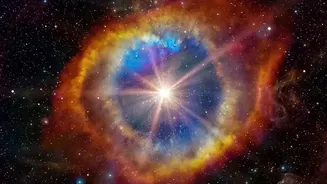
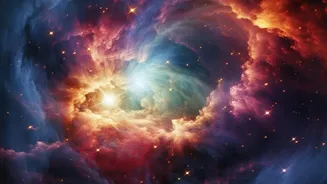
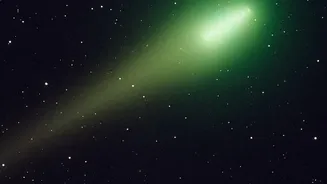
When astronomers first peered at the Helix Nebula with early telescopes, they saw thousands of tadpole-shaped objects, all seemingly streaking away from the central star. With glowing heads and faint tails, they were understandably dubbed "cometary knots."
It’s a catchy name, but a misleading one. Comets are icy bodies of rock and dust orbiting a star. These knots are something else entirely. The resemblance is purely superficial; while a comet's tail is formed by solar wind vaporizing its icy surface, the tails of these knots are created by a completely different cosmic process.
So, What Are They Really?
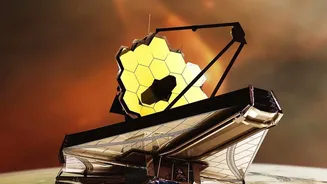
The cometary knots of the Helix Nebula are gigantic globules of gas and dust. Each one is mind-bogglingly vast. The "head" of a single knot can be at least twice the size of our entire solar system, and their tails can stretch for a staggering 100 billion miles. Despite their immense size, their mass is relatively small, often comparable to that of Earth. Recent observations, including those by the James Webb Space Telescope, have revealed them in stunning infrared detail, showing they are dense, cool pockets of molecular gas, primarily hydrogen, embedded within the hotter, more diffuse gas of the nebula. There are an estimated 40,000 of these knots within the Helix Nebula alone.
Forged in Shadow and Stellar Wind
The formation of these knots is a dramatic story of stellar death. The Helix Nebula is a planetary nebula, the cast-off outer layers of a sun-like star that has reached the end of its life. At its center is a scorching hot white dwarf, the star's leftover core. This stellar remnant unleashes a ferocious stellar wind and intense ultraviolet radiation. As this energy slams into the cooler, denser gas the star shed thousands of years earlier, it creates a chaotic scene. The knots form from this collision. The dense clumps of gas and dust are able to shield the material directly behind them from the stellar blast. This creates long, dark "shadows" or tails that point away from the star—the very features that make them look like comets.
A Glimpse into Our Sun's Distant Future
Studying these strange structures is more than just solving a cosmic mystery; it's like looking into a crystal ball for our own solar system. The Helix Nebula is a prime example of what will happen to our Sun in about five billion years. When the Sun exhausts its nuclear fuel, it will swell into a red giant and then puff its outer layers into space, creating its own planetary nebula. The material in these cometary knots represents a crucial phase in galactic recycling. This is how elements forged inside a star are returned to the interstellar medium, where they will eventually clump together to form new stars and planets. By observing the violent, beautiful end of one star's life, astronomers get a front-row seat to the processes that make future worlds possible.