




A New Era for Indian Space-Tech
For decades, a career in India's space industry largely meant one thing: working for the Indian Space Research Organisation (ISRO). Today, that landscape is transforming at an unprecedented pace. The sector has been opened up to private enterprise, leading
to a surge of over 400 startups in fields like satellite manufacturing, launch vehicle development, and data analytics. This privatisation, coupled with ambitious national goals, has turned the space sector into one of the country's most exciting future industries. Valued at over $8 billion and projected to hit $44 billion within the next decade, India's space economy is creating thousands of new jobs and becoming a significant contributor to the national GDP. This new ecosystem, blending government ambition with private innovation, forms the perfect launchpad for the next generation of technological disruption.
AI: The Brains Behind the Mission
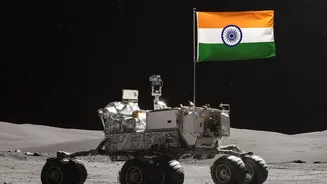
Artificial Intelligence is rapidly moving from a buzzword to a fundamental tool in space operations. ISRO experts have noted that AI and machine learning will be transformative for India's upcoming satellite systems. One of its most powerful applications is in the analysis of vast amounts of satellite data. AI algorithms can sift through terabytes of daily satellite imagery to monitor climate change, improve crop management, and support disaster relief efforts with incredible speed and accuracy. Beyond data analysis, AI is crucial for on-board processing and edge computing, allowing satellites to analyse information in orbit instead of sending raw data back to Earth. This enables faster, real-time decision-making. Furthermore, AI is critical for autonomous systems, such as rovers navigating distant planets, and predictive maintenance, which can identify potential spacecraft failures before they occur. This shift is creating a demand for AI specialists with aerospace knowledge.
The Quantum Leap in Security and Sensing
While AI is already here, quantum technology represents the next frontier. Its primary impact on the space sector is expected in two key areas: communication and computation. ISRO has been actively developing quantum technologies, successfully demonstrating free-space Quantum Key Distribution (QKD) over a distance of 300 metres. QKD uses the principles of quantum mechanics to create encryption keys that are physically impossible to break, offering a new level of security for military communications, financial transactions, and sensitive satellite data. In the long term, quantum computers promise to solve incredibly complex problems that are beyond the reach of even the most powerful supercomputers today. These could be used for designing new materials for spacecraft, optimising complex mission trajectories, and running advanced simulations, significantly speeding up mission design and improving efficiency.
The New Jobs on the Final Frontier
The fusion of AI, quantum, and space is not just enhancing existing roles; it is creating entirely new career paths that didn't exist a few years ago. Demand for traditional aerospace engineers remains strong, but companies are now also hiring for positions like AI and Machine Learning Engineer, Satellite Data Analyst, and Space Robotics Engineer. As these technologies mature, we can expect to see even more specialised roles emerge. These include Quantum Cryptographers to develop secure communication networks, AI Ethics Officers to govern autonomous space systems, and Autonomous Systems Engineers who design the software for self-piloting spacecraft and drones. The sheer volume of data being generated means Data Scientists with a specialisation in aerospace will be in high demand to find meaningful patterns in everything from satellite imagery to telemetry data.
Building the Skillset for Tomorrow
To thrive in this evolving industry, aspiring professionals need a multidisciplinary skillset. A foundation in aerospace or astronautical engineering is still valuable, but it must be complemented with new-age technical skills. Strong programming skills, particularly in languages like Python, are becoming essential. Expertise in AI frameworks such as TensorFlow or PyTorch, combined with experience in data analytics and cloud computing, will provide a significant advantage. For those interested in the quantum side, a background in physics, cryptography, and quantum mechanics will be crucial. Beyond technical abilities, the industry requires strong analytical and problem-solving skills to tackle the unique challenges of space missions. As India's space ecosystem expands, the talent that can bridge the gap between traditional aerospace and emerging digital technologies will be best positioned to lead its next chapter of growth.