



A Thermometer for the Moon
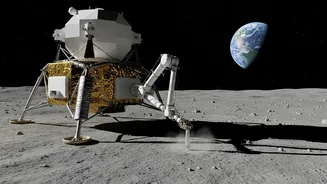
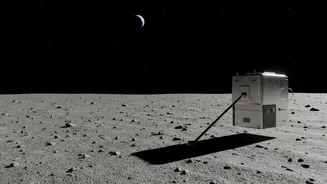
The critical piece of evidence comes from the Chandrayaan-3 mission's Vikram lander. Onboard was a unique instrument named ChaSTE, short for Chandra’s Surface Thermophysical Experiment. Unlike orbital instruments that observe from afar, ChaSTE was designed
for direct contact. It featured a probe that slowly and carefully pushed itself 10 centimetres into the lunar topsoil, or regolith, near the Moon's south pole. Fitted with ten precision temperature sensors, its mission was simple but profound: to take the first-ever direct temperature profile of the top layer of the lunar soil in this high-latitude region. This wasn't just about checking how cold it was; it was about understanding how heat behaves in the lunar environment, a detail with enormous implications.
The Surprising Temperature Gap
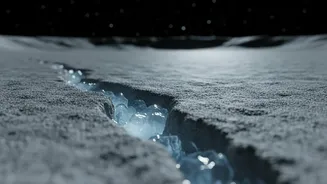
The data sent back by ChaSTE revealed something astonishing. While the lunar surface experienced significant temperature swings, there was a massive drop in temperature just centimetres below. The experiment recorded a dramatic thermal gradient, a sharp difference between the temperature at the surface and at a depth of 10 cm. This finding directly demonstrated that the loose, powdery lunar regolith is an exceptionally poor conductor of heat—in other words, it is a fantastic thermal insulator. The heat from the sun that baked the surface simply wasn't penetrating deep into the soil. This confirmed what models had long predicted but had never been measured in place at these latitudes. The soil acts like a natural, highly effective blanket.
An Insulating Blanket of Dust
This is the core of the discovery and the key to preserving ice. For water ice to remain stable, it needs to be incredibly cold. On the sunlit parts of the Moon, any surface ice would quickly turn into vapour and be lost to space. However, ChaSTE's data provides strong evidence for a preservation mechanism. The exceptional insulating properties of the top layer of regolith mean that even if a region receives sunlight, the soil just a few centimetres below the surface remains shielded from the intense heat. This protective layer of dust prevents the subsurface from warming up enough to cause buried ice to sublimate. As a result, stable water ice could exist at shallow, accessible depths, not just in the extremely cold and difficult-to-reach permanently shadowed regions at the poles.
Why This Finding Changes the Game
The implications of this are huge for the future of space exploration. It significantly broadens the potential search area for lunar water. Instead of being restricted to the treacherous, perpetually dark craters, future missions could potentially find and extract water ice from more accessible, sunlit locations at high latitudes. This makes mission planning safer and more flexible. Water is considered the most critical resource for establishing a long-term human presence on the Moon. It can be used for drinking water and growing plants, and it can be broken down into its components, hydrogen and oxygen. These elements provide breathable air for astronauts and, crucially, can be used to create rocket propellant, effectively turning the Moon into a refuelling station for deeper space missions to Mars and beyond.
India's Contribution to Lunar Science
With the ChaSTE experiment, ISRO has provided a fundamental piece of ground-truth data that will inform lunar science for years to come. By conducting the first-ever in-situ thermal profiling of the near-polar subsurface, India has delivered a key insight into the physical processes that govern the lunar environment. This isn't just a theoretical win; it's practical, foundational knowledge that NASA, the European Space Agency, and other space-faring nations will use to plan their upcoming Artemis and robotic missions. The data helps scientists understand where to look for ice and informs the design of future rovers and extraction equipment. It solidifies India’s position as a leader in lunar exploration, contributing critical knowledge that paves the way for humanity's sustainable return to the Moon.