







The Challenge of Distant Worlds
Since the first confirmed discovery in the 1990s, scientists have catalogued over 5,000 exoplanets—plantes orbiting stars other than our Sun. This cosmic census has revealed an incredible diversity of worlds, from gas giants larger than Jupiter to small,
rocky planets. But the ultimate goal for many is to find a true Earth-twin: a rocky world with liquid water and an atmosphere, the necessary ingredients for life as we know it. The challenge is immense. These planets are incredibly faint and far away, making them impossible to see directly with most current technology. Instead, scientists must infer their properties by observing how they affect their host stars.
Weighing a Planet from Light-Years Away
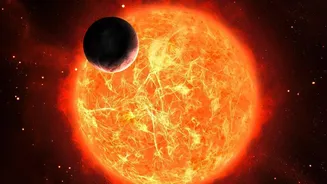
To calculate a planet's density, you need to know two things: its size (radius) and its mass. Both are measured through clever observation. A planet's radius is typically determined using the 'transit method'. When a planet passes in front of its star from our point of view, it blocks a tiny fraction of the starlight, causing a measurable dip in the star's brightness. The bigger the planet, the deeper the dip, allowing astronomers to calculate its size. Measuring mass is often done using the 'radial velocity' method. A planet's gravity causes its host star to 'wobble' slightly. By measuring the subtle shift in the star's light as it moves toward and away from us, scientists can determine the planet's mass. Once you have both mass and radius, calculating the density is simple math.
The Density Spectrum: From Gas to Rock
Density is a crucial first step in characterising an exoplanet. A very low density indicates a planet is mostly gas, like Jupiter or Saturn. A very high density suggests a world made of iron and rock, like Earth or Mars. But the most exciting discoveries often lie in the grey area. Take, for example, the famous TRAPPIST-1 system, which has seven Earth-sized rocky planets. Initial studies found they are all about 8% less dense than Earth. This small difference is a huge clue, suggesting they have a different composition—perhaps less iron and more of other lighter materials. It’s these subtle variations that get astronomers excited.
A 'Puffy' Planet Is a Promising Planet
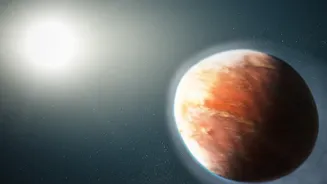
This is where atmospheres come in. Imagine a solid, rocky planet. Now, wrap it in a thick blanket of gas—an atmosphere. This atmosphere adds a lot of volume to the planet but very little mass. The result? The planet's overall density goes down. Therefore, when scientists find a planet that they expect to be rocky based on its mass, but its density is surprisingly low, it's a strong indicator that the planet might be 'puffy' due to a substantial atmosphere. This makes it a prime target for further investigation. The atmosphere doesn't have to be enormous; even a layer that makes up a small fraction of the planet's total radius can significantly lower its average density.
Why an Atmosphere Is the Holy Grail
Finding a rocky planet is one thing, but finding one with an atmosphere is a giant leap toward finding a habitable world. An atmosphere is essential for life as we understand it. It protects the surface from harmful stellar radiation, traps heat to regulate the planet's temperature, and creates the pressure needed for liquid water to exist on the surface. A barren rock in space is unlikely to host life, but a rock with an atmosphere and liquid water is a world of possibilities. Density variations act as a crucial filter, helping scientists narrow down the thousands of known exoplanets to a shortlist of the most promising candidates for harbouring atmospheres.
The Next Step: Sniffing the Air
Once a 'puffy' planet is identified, powerful instruments like the James Webb Space Telescope (JWST) can take the next step. Using a technique called transmission spectroscopy, JWST can analyse the starlight that filters through the planet's atmosphere during a transit. Different molecules in the atmosphere absorb light at specific wavelengths, leaving a unique chemical fingerprint. This allows scientists to not only confirm the atmosphere’s existence but also to determine its composition, searching for gases like water vapour, carbon dioxide, methane, and even potential biosignatures—gases that could be produced by living organisms. Recent detections of helium escaping from the rocky world LHS 1140 b, for example, have made it a high-priority target in the search for habitable worlds.