



The Quadrillion Dollar Rock
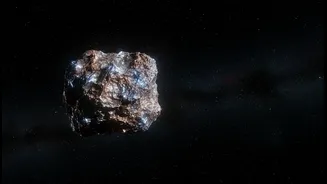
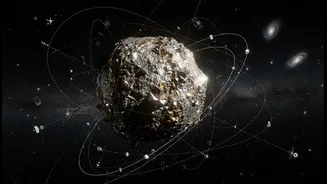
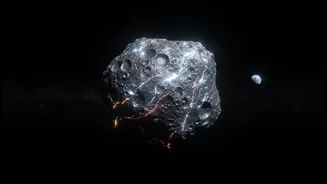
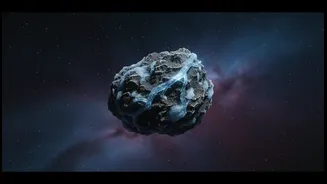
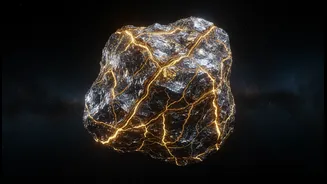
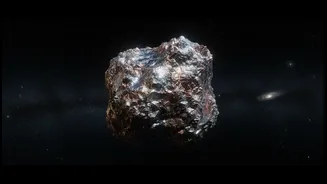
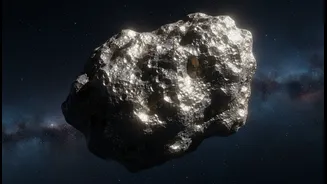
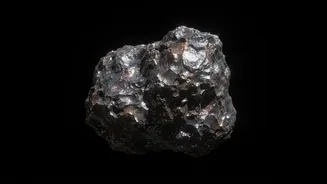
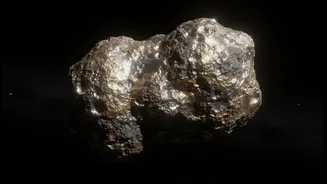
In the main asteroid belt between Mars and Jupiter drifts an object of immense scientific and, potentially, economic interest: 16 Psyche. This is no ordinary space rock. Measuring about 225 kilometres across, scientists believe it could be the exposed
metallic core of a protoplanet—an ancient world whose rocky outer layers were blasted away by cosmic collisions billions of years ago. While most asteroids are stony or icy, observations suggest Psyche is extraordinarily rich in metals like iron and nickel. This has led to some eye-watering, if hypothetical, valuations. Estimates put the value of these metals at a figure as high as $10,000 quadrillion, a sum that makes the entire world's economy look like pocket change. While this number is more of a thought experiment than a serious market valuation, it successfully captures the scale of the resources that might be locked away in this single celestial body. For this reason, Psyche has become the ultimate symbol for the promise of space mining.
A Scientific Scout on a Commercial Frontier
To be clear, NASA's Psyche mission, which launched in October 2023, is purely scientific. Its goal is not to mine the asteroid but to study it, offering humanity its first close-up look at a planetary core. By analyzing its composition, gravity, and magnetic properties, scientists hope to unlock secrets about how planets like Earth formed. However, every piece of data the probe gathers on its way to its 2029 arrival is invaluable for commercial prospectors. The probe's successful Mars gravity assist in May 2026 was a key milestone, confirming the mission is on track and fuelling excitement. This progress is the "new data" that has corporations buzzing. For aspiring space miners, the mission is effectively a multi-billion-dollar reconnaissance flight, providing critical information about the asteroid's makeup and structure that would be impossible to gather from Earth.
The Dawn of a New Gold Rush
The excitement around Psyche is a catalyst for the fledgling asteroid mining industry. A new generation of companies, such as AstroForge, TransAstra, and the Asteroid Mining Corporation, are developing the technologies needed to one day make space resources a reality. Their ambitions are twofold. Firstly, to mine valuable materials like platinum-group metals and return them to Earth. Secondly, and perhaps more importantly in the long run, is to use resources like water (for life support and rocket fuel) and iron (for construction) in space itself. This concept, known as in-situ resource utilization (ISRU), is seen as essential for building a sustainable human presence beyond Earth, from lunar bases to missions to Mars. While Psyche itself is too far for early missions, the data it provides will be a crucial test case for prospecting and characterising other, more accessible near-Earth asteroids.
Turning Science into a Business Plan
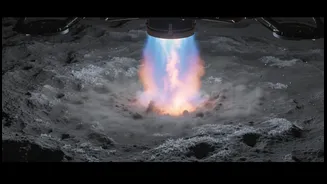
For a mining corporation, a business plan starts with a geological survey. NASA's probe will create the first-ever detailed map of a metallic asteroid. Its instruments will confirm whether Psyche is a solid metal body or a rubble pile of metal and rock—a crucial detail for any future extraction effort. It will analyze the specific composition, confirming the presence and concentration of valuable metals. The mission will also study the asteroid's topography and gravity, which is fundamental for understanding how a future robotic lander could safely touch down and operate on its surface. While NASA is asking scientific questions, commercial players are listening for business answers. Every piece of data reduces the uncertainty and financial risk for subsequent private missions.
Real-World Hurdles in Deep Space
Despite the excitement, the path to mining Psyche, or any asteroid, is fraught with challenges. The technological hurdles are immense, requiring advances in robotics, autonomous systems, and propulsion that are still in early development. The financial costs are, for now, astronomical and far exceed what the private sector can fund alone. Then there is the legal vacuum. The 1967 Outer Space Treaty forbids nations from claiming sovereignty over celestial bodies, but it is ambiguous about the rights to resources extracted from them. Countries like the US and Luxembourg have passed national laws to grant companies rights to the resources they mine, but there is no binding international agreement, creating a 'Wild West' legal environment that could deter major investment.