



A Water World Hiding in Plain Sight
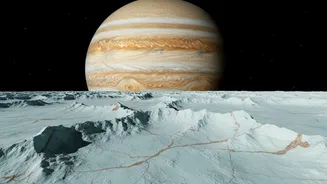
From a distance, Europa looks like a smooth, cracked billiard ball. It’s one of Jupiter's largest moons, but its true marvel lies beneath its frozen surface. Scientific evidence strongly suggests the existence of a global ocean of salty liquid water,
hidden under an ice shell that could be 15 to 25 kilometers thick. This isn't just a small sea; estimates suggest Europa's ocean may contain more than twice the volume of all of Earth's oceans combined. The evidence comes from magnetic field data gathered by the Galileo spacecraft in the 1990s, which detected a magnetic signature consistent with a global, conductive layer—most likely a saltwater ocean. The immense gravitational pull from Jupiter causes tidal flexing, generating enough heat to keep this vast body of water liquid.
Meet the Europa Clipper
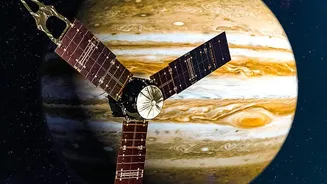
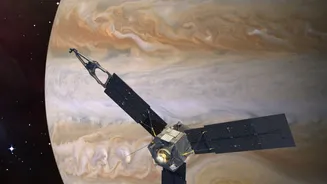
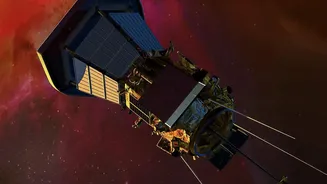
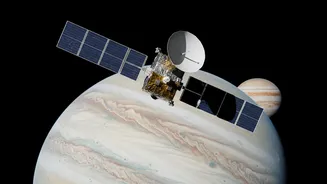
The mission tasked with this grand investigation is NASA’s Europa Clipper. Launched in October 2024, this sophisticated probe is the largest interplanetary spacecraft ever built by the agency. It is currently on a multi-year journey, scheduled to arrive in orbit around Jupiter in April 2030. To get there, it’s using gravity assists, swinging by Mars in March 2025 and Earth in December 2026 to build up speed. Instead of orbiting Europa directly, which would expose it to Jupiter’s intense and damaging radiation, Clipper will loop around Jupiter and perform dozens of close flybys of the moon—about 45 to 50 in total. These passes will bring the spacecraft as close as 25 kilometers (16 miles) above Europa's surface, allowing it to gather unprecedented data.
An Advanced Toolkit for Alien Hunting
Europa Clipper is equipped with a suite of nine advanced science instruments designed to work in concert. Its most crucial tool might be the Radar for Europa Assessment and Sounding: Ocean to Near-surface (REASON). This ice-penetrating radar will probe the moon's frozen shell to confirm the ocean's existence, measure the ice's thickness, and even search for pockets of water trapped within the shell. Other instruments, like spectrometers, will analyze the composition of surface materials, searching for salts and organic compounds. A magnetometer will measure the magnetic field to determine the ocean's depth and salinity, while thermal imagers will look for warm spots where the ocean might be interacting with the ice closer to the surface.
Searching for Habitability, Not Life Itself
It’s important to clarify that Europa Clipper is not a life-detection mission. It doesn't have the tools to find living microbes directly. Instead, its primary goal is to investigate Europa's habitability—to determine if the essential ingredients for life as we know it exist there. These three key ingredients are liquid water, the right chemical elements (like carbon, hydrogen, nitrogen, oxygen, phosphorus, and sulfur), and a source of energy. Clipper will assess the water, scan for these chemical building blocks on the surface, and try to understand the energy sources available, such as heat from tidal flexing. In short, the mission is designed to find out if there are places below Europa's ice that could support life.
The Promise of Plumes
One of the most exciting possibilities for the mission involves potential water vapor plumes erupting from Europa's surface. The Hubble Space Telescope has detected tantalizing hints of these cryogeysers, similar to those confirmed on Saturn's moon Enceladus. If these plumes are real and active, Europa Clipper could fly through them. This would provide a remarkable shortcut, allowing the spacecraft's mass spectrometer to directly sample the chemical makeup of the subsurface ocean without having to drill through miles of ice. However, recent analysis has cast some doubt on the frequency and existence of these plumes, making their potential observation by Clipper a key, but uncertain, objective.