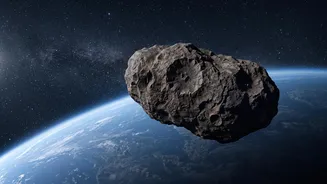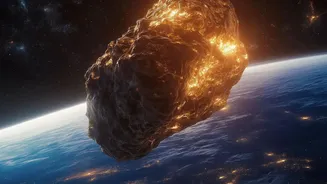



While our familiar Moon has graced the night sky for billions of years, Earth occasionally hosts temporary visitors. One such 'mini-moon,' a tiny asteroid named 2026 QQ8, is nearing the end of its stay in our planet's gravitational grip.
A Fleeting Cosmic Companion
Our planet has
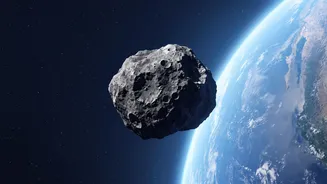
a temporary second moon, but not for much longer. A small asteroid, officially designated 2026 QQ8, was captured by Earth's gravity in April 2026 and is expected to break free sometime between December 2026 and January 2027. This celestial visitor was first spotted in August 2026 by Hungarian astronomer Krisztián Sárneczky. Initially, scientists were unsure if it was a natural object or a piece of human-made space debris, but follow-up observations confirmed it is indeed a natural asteroid, making it a true, albeit temporary, mini-moon. At only about two metres (around six feet) across, it's far too small and distant to be seen without powerful telescopes, but its journey highlights the dynamic and ever-changing nature of our solar system.
What Exactly Is a Mini-Moon?
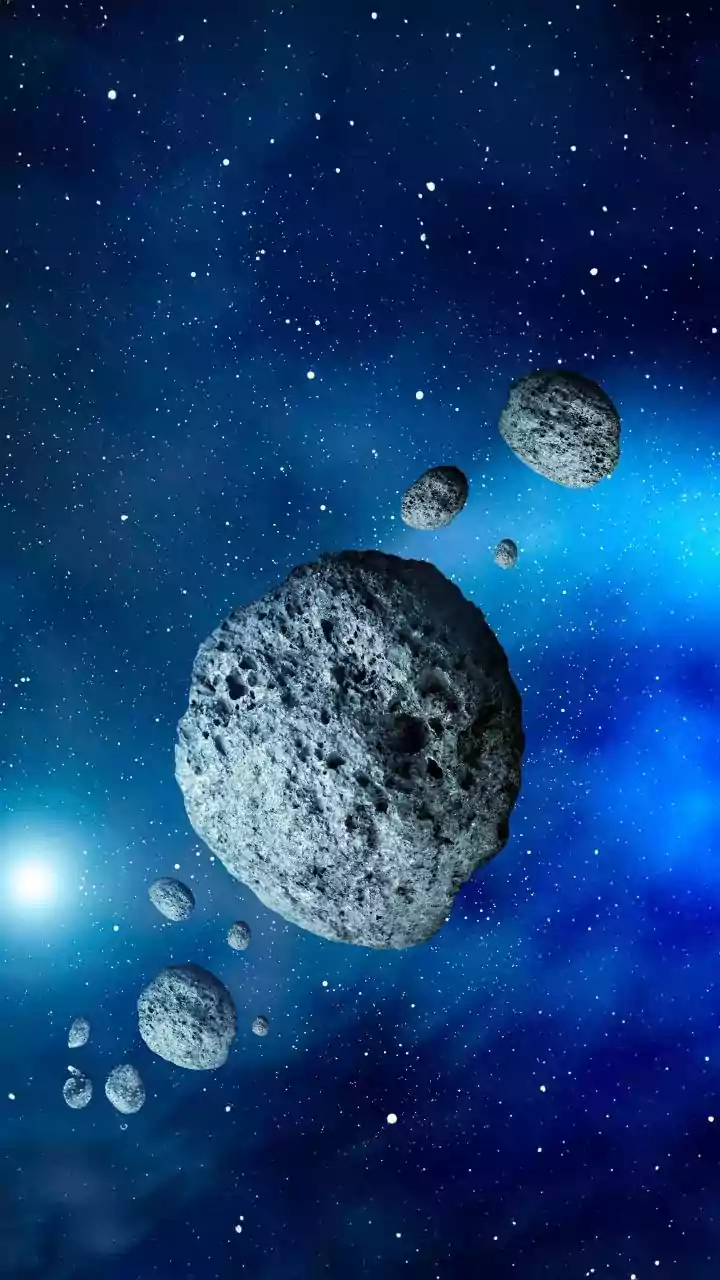
The term 'mini-moon' isn't an official scientific classification but a nickname for asteroids or other near-Earth objects that are temporarily captured by our planet's gravity. Unlike our large, permanent Moon, these objects don't settle into a stable orbit for billions of years. Instead, they are caught in a complex gravitational dance between the Earth, the Moon, and the Sun. Most get pulled into a chaotic, looping path for a few months or years before the Sun's stronger gravitational pull inevitably slings them back into their own orbit around the star. Scientists believe that at any given time, Earth is likely hosting at least one mini-moon of about a metre in diameter, though their small size makes them incredibly difficult to detect.
The Story of 2026 QQ8
The journey of 2026 QQ8 is a perfect example of this cosmic process. This particular asteroid orbits the Sun in a path very similar to Earth's, taking about 359 days to complete a circuit. This brings it close to our planet roughly every 10 years. During its 2026 approach, its trajectory, speed, and angle were just right for it to cross into what astronomers call the Hill sphere—the region of space where Earth's gravity is the dominant force over the Sun's. Once inside this sphere, it was captured. However, its orbit is not a neat circle; it's a wobbly, unstable path about 1.5 times farther away than our main Moon. There is no danger of it colliding with Earth. Even if it were on a collision course, a rock this small would simply burn up as a bright fireball in our atmosphere.
The Great Escape
All temporary relationships come to an end, and 2026 QQ8's time as our mini-moon is almost over. Its unstable orbit means it cannot resist the gravitational influence of the Sun forever. Projections show it will drift out of Earth's Hill sphere in early 2027, continuing its solitary journey around the Sun. While we will be saying goodbye to this specific mini-moon, it won't be the last time we see it. Its orbit is predicted to bring it close to Earth again in 2058, though it is not expected to be recaptured during that pass. The discovery and departure of objects like 2026 QQ8 remind us that the solar system is not a static clockwork mechanism but a place of constant motion and fleeting encounters.