



A Panoramic Window to the Cosmos
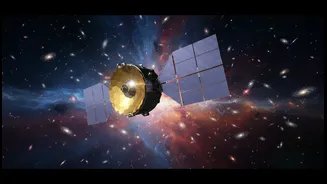
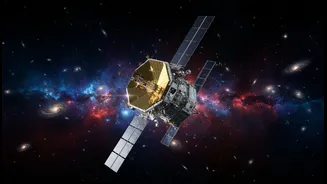
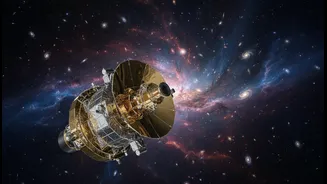
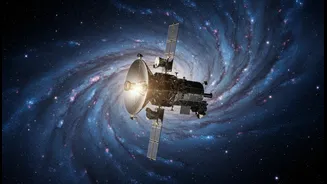
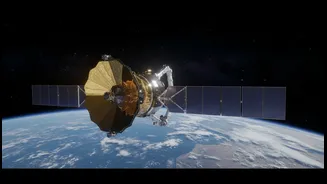
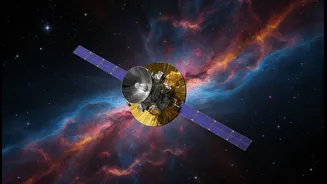
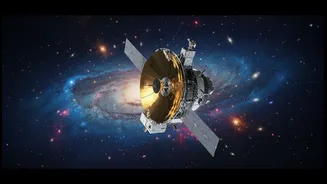
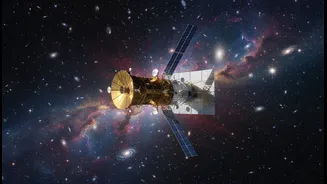
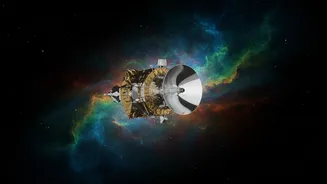
The Nancy Grace Roman Space Telescope isn't just another eye in the sky; it's a cosmic surveyor of unprecedented scale. Named after NASA's first chief of astronomy, this flagship observatory has a primary mirror the same size as Hubble's but boasts a field
of view at least 100 times larger. This means that for every snapshot Hubble takes, Roman can capture a panoramic vista, allowing it to map huge swathes of the universe with incredible speed and detail. Its core missions are profound: to unravel the mysteries of dark energy and dark matter, and to conduct a massive census of exoplanets, with projections suggesting it could discover over 100,000 new worlds. By using techniques like gravitational microlensing, Roman will find planets that other methods miss, giving us a more complete picture of planetary systems across our galaxy. It is not a replacement for the James Webb Space Telescope (JWST), but a powerful partner; Roman will find the cosmic points of interest, and Webb can then zoom in for a closer look.
The Intense Pressure of the Launchpad
Getting a multi-billion-dollar observatory one million miles from Earth is a monumental undertaking. The Roman Telescope is currently slated to launch aboard a SpaceX Falcon Heavy rocket on August 30, 2026. For any major NASA project, the launch date becomes a focal point for the agency, for politicians, and for the public. Years of development, billions in taxpayer funding, and the careers of hundreds of scientists and engineers all culminate in a few moments of controlled fire and force. This intense focus creates what can be called "launch fever." The pressure to meet a specific date, stay within budget, and deliver a flawless liftoff is immense. While the Roman project has been lauded for being ahead of schedule, this success only amplifies the expectation of a perfect launch day. But this is precisely where the danger lies. When the launch itself is seen as the finish line, the mission's true purpose can get lost in the celebration.
The Danger in Confusing Departure with Destination
The central risk for the Roman Telescope is one of perspective: the failure to separate the engineering success of the launch from the scientific success of the mission. Space exploration history is littered with projects that faced immense pressure, and sometimes the focus on getting off the ground overshadowed the long-term goals. The James Webb Space Telescope, for instance, saw its budget swell from initial estimates and its launch delayed by years, creating enormous stress on the program. A project's success becomes defined by hitting its launch date, a metric that has little to do with the quality of data it will produce over its five or ten-year primary mission. This mindset can lead to subtle but critical compromises. It can discourage teams from raising late-stage concerns for fear of causing a delay, or it can frame public expectations in a way that any post-launch anomaly is seen as a catastrophic failure rather than a challenge to be overcome.
Science Is a Marathon, Not a Sprint
The Hubble Space Telescope provides the ultimate cautionary tale and, ultimately, a lesson in patience. It launched in 1990 with a flawed primary mirror, a technical failure that made its initial images blurry and turned a moment of anticipated triumph into a national embarrassment. By the logic of "launch fever," Hubble was an instant failure. But the story didn't end there. Because it was designed to be serviced, astronauts were able to install corrective optics, and Hubble went on to become arguably the most productive scientific instrument in history. Its decades of discovery were completely independent of its flawed opening night. The real value of Roman, like Hubble and Webb, will not be known on launch day. It will be measured in the papers published five years from now, in the PhDs earned a decade from now, and in the fundamental questions about our universe that it helps answer for the next generation. The science is a marathon that only begins once the telescope reaches its stable orbit at the second Lagrange point (L2).