


A New Cosmic Perspective
In astronomy, the 'field of view' determines how much of the sky a telescope can see at once. For decades, telescopes like the Hubble Space Telescope have given us stunning, detailed, but narrow glimpses of the cosmos, much like looking at a sprawling
landscape through a keyhole. The Nancy Grace Roman Space Telescope, named after NASA's first chief of astronomy, changes the game entirely. It’s designed not for the keyhole view, but for the panoramic window. Its primary tool, the Wide Field Instrument (WFI), is a 300-megapixel infrared camera engineered to capture vast swathes of the universe in a single shot while maintaining the incredible sharpness associated with Hubble. Each image from Roman will cover a patch of sky larger than the apparent size of a full moon.
By the Numbers: Roman vs. Hubble
The scale of Roman's advantage is staggering. Its field of view is at least 100 times larger than Hubble’s comparable infrared instrument. What Hubble took 432 separate images to capture, Roman can cover in just two. In its first five years, Roman is projected to image over 50 times the amount of sky Hubble has in its entire three-decade history. This isn't just about seeing more; it's about seeing faster. Roman can survey the sky up to 1,000 times faster than Hubble, allowing it to create unprecedented maps of the cosmos. Think of it as the difference between taking a single, perfect portrait and creating a high-resolution map of an entire city in the same amount of time. This efficiency is what allows Roman to tackle some of astronomy's biggest and most data-intensive questions.
Unlocking the Secrets of Dark Energy
One of Roman’s primary missions is to investigate dark energy, the mysterious force causing the universe's expansion to accelerate. To do this, astronomers need to measure the positions and distances of millions of galaxies and supernovae across cosmic time. This requires a massive statistical sample that would take other telescopes centuries to acquire. Roman’s wide-angle lens is perfect for the job. By rapidly surveying huge patches of the sky, it will map the distribution of billions of galaxies and detect thousands of distant supernovae. These large-scale structure maps will help scientists trace the history of cosmic expansion and determine the nature of dark energy with unparalleled precision.
A Revolutionary Hunt for Exoplanets
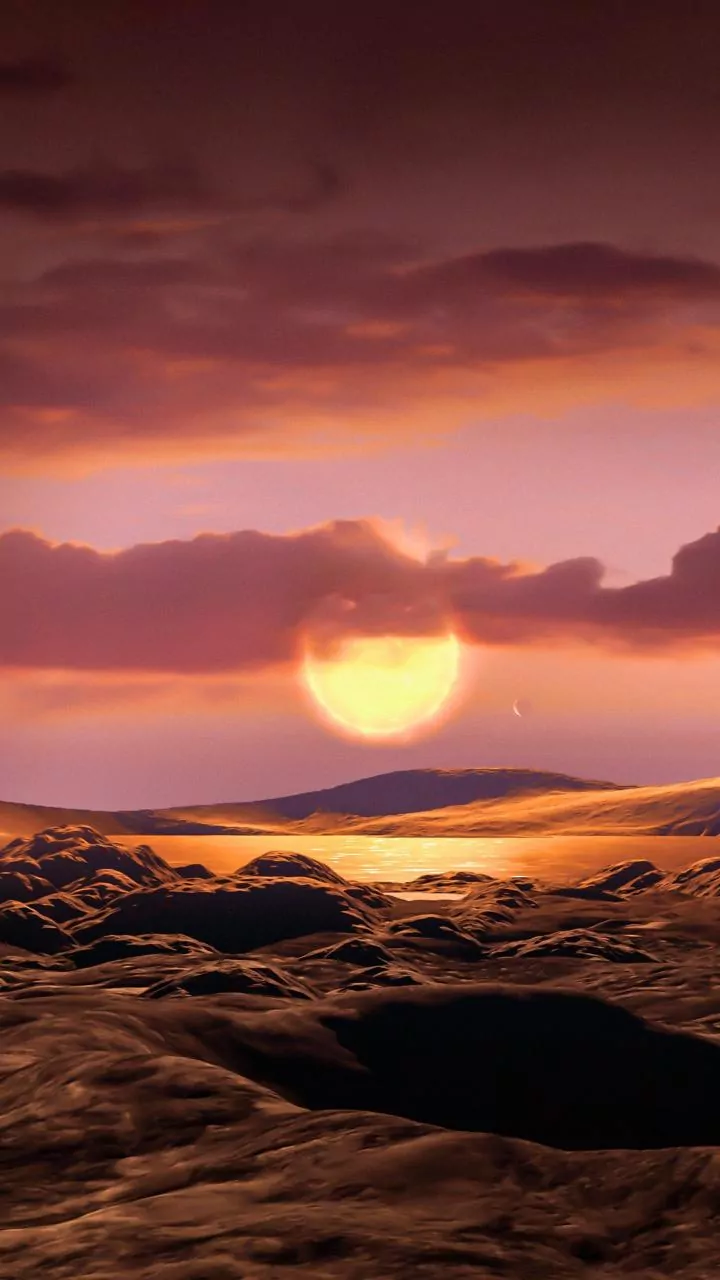
Roman will also revolutionize the search for planets outside our solar system. While missions like Kepler and TESS look for the dimming of starlight as a planet transits its star, Roman will heavily rely on a different technique: gravitational microlensing. This phenomenon occurs when a star and its planets pass in front of a more distant star, and their gravity acts like a lens, briefly magnifying the background starlight. These events are extremely rare and unpredictable, so the only way to catch them is to monitor millions of stars at once. Roman’s ability to stare at the crowded central bulge of our Milky Way galaxy makes it the ideal instrument for this task. Scientists expect Roman to discover thousands of new exoplanets this way, providing a new census of worlds in our galaxy.
The Ultimate Cosmic Scout
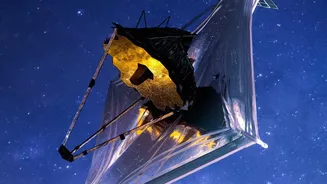
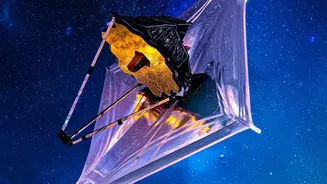
Instead of replacing telescopes like the James Webb Space Telescope (JWST), Roman is designed to be a powerful collaborator. The two have complementary strengths: Roman is the wide-angle scout, and Webb is the deep-diving specialist. Roman will rapidly survey huge areas of the sky, identifying rare and interesting targets—the most distant galaxies, unusual supernovae, or intriguing planetary systems. Once Roman finds these cosmic curiosities, Webb can use its powerful instruments to zoom in and study them in exquisite detail, analyzing their chemical composition, temperature, and motion. This powerful synergy will allow astronomers to get a far more complete picture of the universe than either observatory could achieve on its own.