




A Library Written in Ice
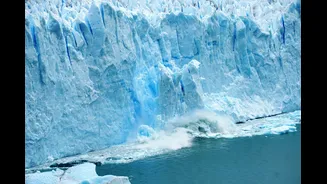
In the vast, frozen landscapes of Antarctica and Greenland, years of snowfall accumulate, one layer at a time. As new snow buries the old, the immense pressure transforms the lower layers into dense glacial ice. This process creates a vertical timeline
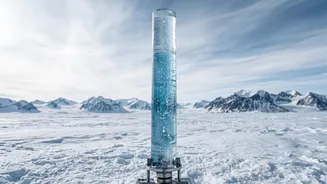
stretching back hundreds of thousands of years, with the oldest ice lying deep below the surface. Scientists drill deep into these ice sheets, sometimes over three kilometres, to extract long cylinders of ice called cores. Each core is a chronological archive, preserving physical evidence of the Earth's environment from the moment that snow first fell.
Trapping Ancient Atmospheres
The true magic of ice cores lies in what they hold within. As snow falls, it has pockets of air between its delicate crystals. When this snow is buried and compressed, it first forms a granular, porous layer called firn. For a time, air can still circulate through it. Eventually, at depths of around 50 to 100 meters, the pressure becomes so great that these pores seal off completely, trapping the air as tiny, isolated bubbles within the solid ice. Each bubble is a perfect, miniature sample of the atmosphere from that specific time, preserved for millennia. This process gives scientists a direct look at the air our ancestors breathed.
How to Read a Frozen Clock
Determining the age of the ice is a critical step. For more recent layers, scientists can count the annual bands of ice, which often have visible differences between summer and winter snowfall, much like counting tree rings. Deeper in the core, these layers become compressed and harder to distinguish. To date the older ice, researchers rely on other clues. Layers of ash from ancient volcanic eruptions, which can be independently dated, serve as crucial time markers. Scientists also use mathematical models of how ice flows and compacts over time, as well as chemical analysis of isotopes in the water molecules, to construct a reliable age scale for the entire core.
The Contents of a Pre-Industrial Bubble
In a laboratory, scientists carefully extract the ancient air. The ice is typically crushed or melted inside a vacuum chamber, which releases the gas from the trapped bubbles. This captured air is then analyzed, often with a device called a mass spectrometer, to precisely measure its chemical composition. The analysis reveals the exact concentrations of key atmospheric gases, most importantly greenhouse gases like carbon dioxide (CO2), methane (CH4), and nitrous oxide (N2O). This is not an estimate or a proxy; it is a direct measurement of the air from a bygone era.
What the Ice Tells Us
These frozen air samples have provided irrefutable evidence of our changing planet. The data from ice cores stretching back 800,000 years shows that for millennia, CO2 concentrations in the atmosphere naturally fluctuated within a stable range, typically between 180 and 300 parts per million (ppm). But beginning in the 19th century, right at the dawn of the Industrial Revolution, those levels began to climb sharply. The cores show a rate of increase in the last two centuries that is unprecedented in the entire 800,000-year record. This establishes a clear pre-industrial baseline, demonstrating that today's atmospheric CO2 levels, now well over 400 ppm, are far outside the range of natural variability seen over countless glacial cycles.