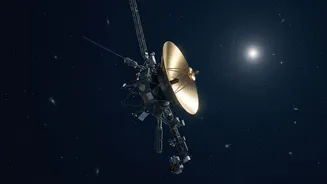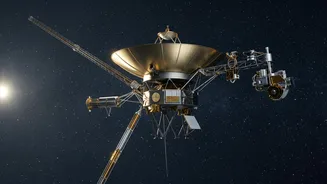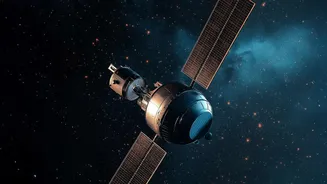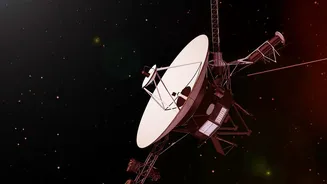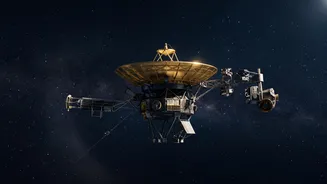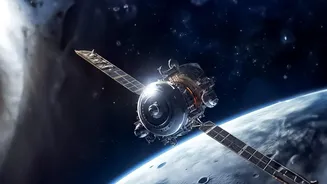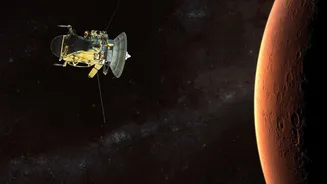


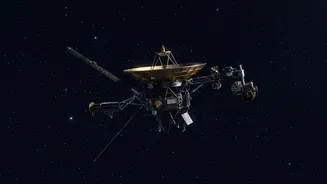

Launched nearly 50 years ago, a relic of 1970s engineering is about to achieve something unprecedented. NASA’s Voyager 1 probe, our farthest messenger, is on the verge of being a full light-day away from home. Here’s why that’s so much more than just
a number.
A Journey Measured in Light
On November 18, 2026, Voyager 1 will be one light-day from Earth, a distance of about 25.9 billion kilometres. To put that in perspective, light, the fastest thing in the universe, takes 1.3 seconds to reach the Moon and about 8 minutes to travel from the Sun to Earth. But it will take a full 24 hours for a radio signal from Voyager 1 to reach us. This means any command sent by NASA's Jet Propulsion Laboratory (JPL) requires a two-day wait for a response, a testament to the immense scale of the probe’s journey. The milestone isn't just a record; it’s a tangible measure of humanity's reach into the cosmos, achieved by a machine launched when the world was a very different place.
The Grand Tour's Last Ambassador
Voyager 1, and its twin Voyager 2, were born from the ambitious 'Grand Tour' concept of the 1960s. Launched on September 5, 1977—16 days after its twin—it took a faster, more direct route to the outer solar system. Its primary mission was a breathtaking flyby of Jupiter in 1979 and Saturn in 1980. It gave us our first detailed look at Jupiter’s swirling storms and discovered the first active volcanoes beyond Earth on the moon Io. At Saturn, it unveiled the complexities of its iconic rings and studied its largest moon, Titan. Having completed its planetary tour, Voyager 1's trajectory flung it upwards out of the plane of the solar system, on a path toward the stars. In February 1998, it officially became the most distant human-made object in space, a title it has held ever since.
An Aging Explorer's Resilience
Keeping a nearly 50-year-old spacecraft alive in the harsh environment of interstellar space is a monumental challenge. Powered by the slow decay of plutonium, its energy supply dwindles by about four watts each year. This forces engineers to make difficult choices, shutting down instruments one by one to conserve power. The probe has also faced recent drama. In late 2023, it began sending back gibberish, a problem that left it unable to transmit usable data for five months. In a stunning feat of long-distance engineering, the JPL team diagnosed a failed memory chip and, in April 2024, uploaded a clever software patch across billions of kilometres to bypass it. More recently, in October 2026, the probe went silent for 48 hours before autonomously bringing its backup thrusters online and re-establishing contact, a move that both relieved and puzzled its handlers.
Whispers from Interstellar Space
In August 2012, Voyager 1 crossed the heliopause, the boundary where the Sun's magnetic field and solar wind give way to the interstellar medium, becoming the first human object to enter the space between stars. Today, with just two of its ten original science instruments still active, it continues to send back invaluable data about this uncharted territory. It measures the density of interstellar plasma and the strength and direction of the galactic magnetic field, information that can't be gathered from within our solar system's protective bubble. This final phase of its mission is helping scientists understand the environment our solar system moves through. Though its cameras were turned off in 1990 after taking the iconic 'Pale Blue Dot' photo, its other senses are still telling us what lies beyond.