

The Radio Wave Bottleneck
Since the dawn of the space age, missions have relied on radio waves to send and receive data. While reliable, radio waves have a fundamental limitation: they spread out over vast distances. Think of it like a torch beam that gets wider and dimmer the farther
it shines. By the time a radio signal from Mars reaches Earth, it is incredibly faint and dispersed. This means we can only send and receive small packets of data at a time, making the transmission of high-resolution images and video a painstakingly slow process. This growing data bottleneck is a major hurdle for future ambitious missions, especially those involving human explorers who will need to send and receive large amounts of information quickly.
Lasers: A Focused Solution
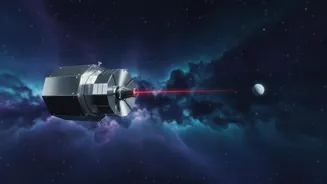
Laser, or optical, communication uses infrared light to carry information. The key difference is that laser light is far more focused. Instead of a wide torch beam, it's like a laser pointer. Because the beam is so tightly collimated, much more of its energy and the data it carries reaches the target receiver, even across millions of kilometres. This is possible because infrared light has a much higher frequency than radio waves, allowing engineers to pack significantly more data into each transmission. The result is a massive leap in bandwidth, with data rates potentially 10 to 100 times faster than the best radio systems.
NASA's Psyche Mission Puts It to the Test
This technology isn't just theoretical; it's already being proven in deep space. NASA's Deep Space Optical Communications (DSOC) experiment, riding aboard the Psyche spacecraft, is a prime example. In a landmark test, the system beamed a high-definition video of a cat named Taters from 31 million kilometres away. The transmission achieved a speed of 267 megabits per second (Mbps), a rate comparable to terrestrial broadband internet. Even from a distance of 226 million kilometres, the system maintained a speed of 25 Mbps, far outperforming what radio waves could achieve. These tests have successfully demonstrated that laser communication is a viable and robust solution for the data demands of future space exploration.
Challenges of Hitting a Faraway Target
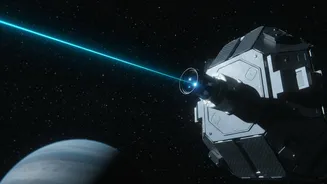
Transmitting data via laser is not without its challenges. The primary difficulty is the extreme precision required. Because the laser beam is so narrow, a spacecraft must aim it with incredible accuracy to hit a receiver on Earth that is itself a moving target. To achieve this, ground stations on Earth first fire a powerful laser beacon towards the spacecraft. The spacecraft's transceiver then locks onto this beacon to perfectly align its return transmission. Another challenge is weather, as clouds can block the laser signal. To mitigate this, a network of ground stations in different locations will be needed to ensure there is always a clear line of sight to a receiver.
A New Era for Space Exploration
The successful demonstration of deep space laser communication marks a pivotal moment. The ability to transmit data at high speeds will transform robotic and human exploration. Scientists will be able to receive vast amounts of complex data, accelerating discovery. Imagine receiving a complete, high-resolution map of Mars in just nine days instead of the nine weeks it would take with radio technology. For future crewed missions to Mars, it means astronauts will have reliable, high-speed contact with Earth, enabling them to stream HD video and share their experiences in near real-time. This technology not only makes missions more efficient but also more secure, as the narrow beams are much harder to intercept or jam.