






The Promise of Unbreakable Communication
At its core, the push to integrate quantum technology into space is about security. Conventional encryption, which protects everything from banking to military communications, relies on complex mathematical problems. While difficult for today's computers
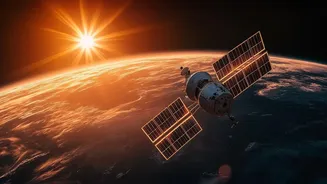
to solve, the rise of powerful quantum computers could render these methods obsolete. Quantum communication offers a solution based on the laws of physics itself. The leading application is Quantum Key Distribution (QKD). In simple terms, QKD uses particles of light (photons) to create an encryption key between two parties. The very act of an eavesdropper trying to intercept and measure these photons disturbs their quantum state, immediately alerting the users to a security breach. This makes the communication channel theoretically 'unhackable'. By placing this technology on satellites, India could create a wide-ranging, ultra-secure network impervious to future cyber threats.
India's Quantum Leap into Orbit
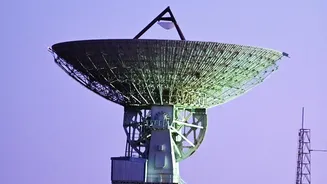
The Indian Space Research Organisation (ISRO) is actively working to turn this theory into reality. A major milestone was achieved when ISRO successfully demonstrated free-space QKD over a distance of 300 meters. This ground-based test, which included a live video conference using quantum-encrypted signals, proved the viability of the indigenously developed hardware. The next logical step is taking this capability to space. These efforts are backed by the National Quantum Mission (NQM), a significant government initiative approved in 2023 with a budget of over ₹6,000 crore. A key objective of the NQM is to develop satellite-based secure quantum communication between ground stations over a range of 2,000 kilometers within India, positioning the country among a select few nations with such ambitions.
More Than Just Secure Messages
While secure communication is the most immediate and strategic application, the benefits of quantum-enabled satellites extend much further. Another area of focus is quantum sensing. These highly sensitive devices could lead to next-generation satellites capable of measuring Earth’s gravitational and magnetic fields with unprecedented accuracy. This would have profound implications for climate monitoring, natural resource exploration, and disaster management. Furthermore, the National Quantum Mission also aims to develop high-precision atomic clocks, which are crucial for navigation systems. Integrating these advanced clocks into India’s own navigation constellation, NavIC, would enhance its accuracy and reliability, reducing dependence on foreign systems. In the long term, a network of quantum-enabled satellites could even form the backbone of a future 'quantum internet', connecting quantum computers across the globe.
The Challenges on the Final Frontier
The journey is not without its hurdles. The space environment is incredibly harsh. Quantum states are fragile and can be easily disrupted by radiation and extreme temperature fluctuations, a phenomenon known as decoherence. Engineers face the immense challenge of designing hardware that can protect these delicate states and operate reliably for years in orbit. The cost of such missions is another significant factor. Furthermore, India is entering a competitive field. China successfully launched its 'Micius' quantum satellite years ago, demonstrating satellite-based quantum communication over vast distances and setting a high benchmark. To succeed, India will need sustained investment, continued innovation from institutions like ISRO and the Raman Research Institute, and a robust collaboration between government, academia, and industry to build a thriving quantum ecosystem.