







The Sound of Silence for Pests
In the ongoing quest for sustainable agriculture, the battle against pests has largely been fought with chemicals. But a fascinating and environmentally friendly alternative is gaining ground: acoustic pest control. The concept leverages biotremology,
the study of vibrations produced by living things. Many insects, from leafhoppers to stink bugs, communicate using subtle, substrate-borne vibrations—think of it as a secret language transmitted through plant stems and leaves. This technology works by essentially hijacking that communication channel. By introducing disruptive vibrations or 'noise,' scientists can interfere with critical insect behaviors. It’s not about blasting pests with loud noises, but rather creating a specific frequency that makes it impossible for them to find mates, locate food, or sense danger, compelling them to leave the area.
How a Bad Vibration Ruins a Bug's Day
The mechanism behind this technology is surprisingly elegant. Researchers first identify and digitize the specific vibrational signals used by a target pest species for activities like mating. Then, devices attached to the plants or their support structures, like trellis wires, play back a disruptive signal. This can take several forms. One effective method is 'mating disruption,' which acts like a jamming signal, masking the 'songs' insects use to find each other. In field studies on grapevines, this technique dramatically reduced the mating frequency of a common leafhopper pest. Another approach uses rivalry signals—the vibrations male insects use to ward off competitors—to trick males into thinking the area is already overcrowded. For some pests, a constant, irritating 'white noise' vibration is enough to make the environment inhospitable, encouraging them to move on without the need for deadly force. This humane approach keeps pest populations below damaging thresholds without eliminating them entirely, which helps preserve the local ecosystem.
A Perfect Match for Urban Farms
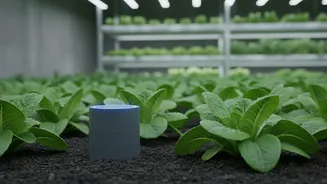
While this technology has been tested in open fields, it finds a particularly compelling application in the controlled environments of urban and vertical farms. These indoor operations are central to the future of local food production in cities, but they are highly susceptible to pest infestations that can ruin an entire crop. Using chemical pesticides indoors is often undesirable and complicated. Acoustic pest deterrence offers a clean, contained solution. Since sound waves don't travel well through the air and can be confined to the plant structures, there is minimal risk of them affecting workers or adjacent areas. Furthermore, the technology can be precisely calibrated for the specific pests common to greenhouse environments. This non-toxic, residue-free method aligns perfectly with the consumer demand for organic, locally grown produce that drives much of the urban agriculture market.
From Lab to Lettuce: The Road Ahead
Acoustic pest control is moving from theory to practice, but it's not a silver bullet just yet. The effectiveness can vary based on the pest, the crop, and the method of delivery. One of the main challenges is scalability—transmitting vibrations effectively across a large greenhouse or vertical farm requires careful engineering. Another is the simple fact that insects are diverse; a frequency that deters one species might have no effect on another. Research is underway to create devices that can emit multiple frequencies or even use machine learning to identify and respond to the specific sounds of pests as they appear. Despite these hurdles, and a history of consumer ultrasonic devices being met with skepticism, the science-backed application in agriculture shows significant promise. Companies and university research teams, including work supported by the USDA, continue to refine the technology, aiming to create commercially viable systems that offer farmers a powerful new tool.