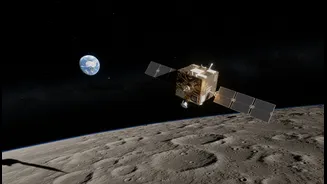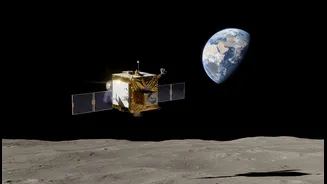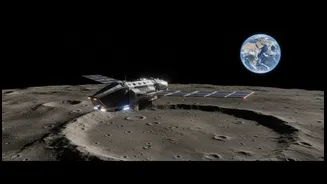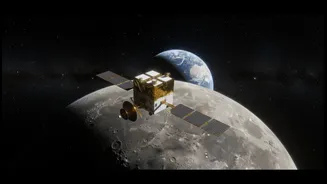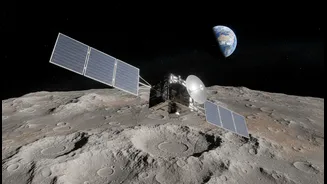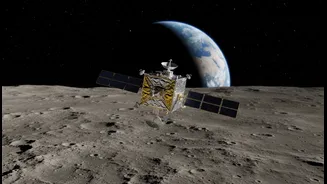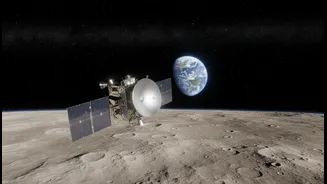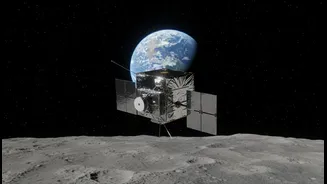




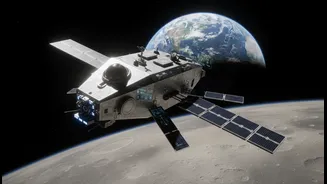
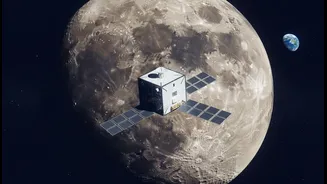
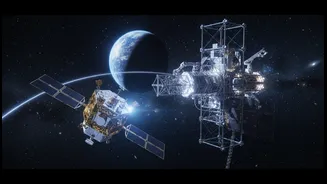


First Off, What Is CAPSTONE?
CAPSTONE is an acronym for Cislunar Autonomous Positioning System Technology Operations and Navigation Experiment. Launched in June 2022, this small but mighty CubeSat is a partnership between NASA and a commercial company, Advanced Space. Its main job
isn't to land on the Moon or search for aliens, but to serve as a trailblazer for NASA’s Artemis program. Think of it as a scout sent ahead to survey a new and unproven route. Weighing only 25 kg, CAPSTONE’s primary mission was to be the very first spacecraft to enter and successfully operate in a special type of lunar orbit, providing vital data for future, larger missions, most notably the planned Lunar Gateway space station.
The Big Deal: A Groundbreaking Orbit
The "special route" CAPSTONE is testing is called a Near-Rectilinear Halo Orbit, or NRHO. Unlike the low, circular orbits of the Apollo era, the NRHO is a highly elliptical, egg-shaped path that takes the spacecraft far from the Moon (about 70,000 km) and then swoops in for a close pass (around 1,600 km). This unique trajectory is located at a gravitational sweet spot, balanced between the pull of the Earth and the Moon. The result is a remarkably stable orbit that requires very little fuel for a spacecraft to maintain its position. This makes it an ideal staging point for long-term missions like the Gateway, as it offers constant communication with Earth and efficient access to the lunar south pole. CAPSTONE’s job was to prove that this complex orbit, which was only theoretical, actually works in practice.
A 'GPS' for the Moon
Beyond testing the orbit, CAPSTONE had another key objective: to demonstrate a new, autonomous navigation system. Currently, spacecraft in deep space rely on constant communication with giant antennas on Earth to know where they are. This is a bit like needing to call home for directions every few minutes. As cislunar space gets busier, this system will become a bottleneck. CAPSTONE tested the Cislunar Autonomous Positioning System (CAPS), a technology designed to let spacecraft determine their own position by communicating with other lunar satellites, like NASA's Lunar Reconnaissance Orbiter (LRO). This spacecraft-to-spacecraft navigation is a crucial step towards creating a sort of GPS for the Moon, allowing future missions to operate more independently.
Hype vs. Reality: What CAPSTONE Doesn't Do
The excitement around the Artemis program can lead to big claims. It’s important to understand that CAPSTONE is a technology demonstration mission. It is not landing on the Moon, searching for water ice, or building a lunar base. Its purpose is focused and specific: to validate the NRHO and test new navigation software. While it faced some challenges after launch, including a temporary loss of communication and a tumbling issue that took weeks to resolve, the mission successfully recovered and completed all its primary and extended goals. Its success isn't measured in dramatic discoveries, but in the quiet, steady collection of data that reduces risk for the astronauts and multi-billion-dollar hardware that will follow.
A Mission Accomplished, and Then Some
CAPSTONE launched in June 2022 and successfully entered its target orbit in November 2022. It completed its six-month primary mission in May 2023, having verified the stability of the NRHO and proven its navigation tech works. NASA then extended its mission, allowing it to continue collecting data and serve as a testbed for other advanced software and communication technologies. After nearly four years of successful operations, NASA concluded its official activities on the mission in June 2026. However, the spacecraft continues to be operated by its owner, Advanced Space, providing ongoing demonstrations for future missions. It has successfully paved the way, proving that this new path to the Moon is viable.