






An Unexpected Battlefield
Tropical forests, from the Amazon to the Western Ghats, are global powerhouses of biodiversity and carbon storage. Their health is critical to planetary stability. For a long time, the primary threat was seen as deforestation. Now, scientists are increasingly
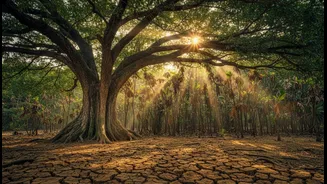
focused on a more insidious problem: drought. Severe and prolonged dry spells, once rare, are becoming more common, pushing even the wettest forests to their limits. This water stress doesn't just reduce growth; it can lead to widespread tree mortality, potentially transforming these vital carbon sinks into carbon sources. But the way a forest responds to drought is not uniform. The struggle for water plays out differently across the forest's architecture, especially between the giants of the canopy and the smaller trees dwelling in their shadow.
The Tall Tree’s Gamble
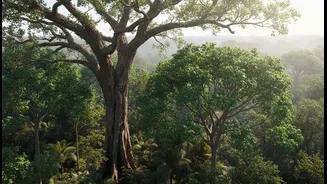
Reaching for the sun, the tallest trees in the rainforest are masters of their domain. However, their height is both a strength and a critical weakness during a drought. To transport water from roots to leaves hundreds of feet in the air is a massive fight against gravity. This requires their internal plumbing—the xylem—to maintain an unbroken column of water under immense tension. During a drought, as soil moisture disappears, this tension can become so great that air bubbles, or embolisms, form in the xylem, catastrophically breaking the water supply. This is known as hydraulic failure, and it can be fatal. For years, the prevailing theory was that this made the tallest trees the most vulnerable to drought. However, recent research reveals a surprising resilience. Some giant trees have adapted by developing wider xylem vessels at their base, akin to upgrading a narrow pipe to a fire hose, to move water more efficiently. Their uppermost leaves are also adapted to function with less water, rewiring their own physiology to cope.
The Small Tree’s Struggle
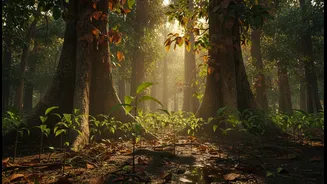
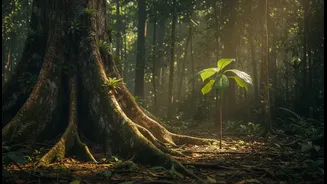
Life in the understory presents a different set of challenges. Smaller trees are shielded from the direct sun and wind, living in a more humid microclimate. This would seem to be an advantage during a drought. However, they are in a fierce, subterranean competition for a shared, dwindling resource: soil water. While giant trees can have deep, extensive root systems that tap into lower water tables, smaller trees often have shallower roots, making them highly susceptible when the top layers of soil dry out. Studies have shown that while canopy trees can sometimes expand their leaf cover during dry seasons to capitalize on increased sunlight, understory trees may be forced to drop their leaves. Yet, these smaller trees also possess a remarkable capacity for adjustment. Research indicates that understory trees have a greater ability to modify their hydraulic traits in response to prolonged drought, showing a surprising level of adaptability that is crucial for the forest's future regeneration.
A Forest of Different Strategies
The key takeaway is that there is no single story of drought vulnerability. Instead, the forest is a mosaic of different survival strategies. Some species are 'isohydric', meaning they close their leaf pores (stomata) early in a drought to conserve water at the cost of ceasing photosynthesis. Others are 'anisohydric', keeping their stomata open longer to continue feeding, but risking deadly hydraulic failure. These strategies aren't just species-dependent; they are shaped by a tree's size, its access to light, and its specific location. Small trees in the shaded understory might have a greater safety margin from embolism but face intense competition, while tall trees have better access to light but live on a hydraulic knife-edge. This diversity of responses is what makes the ecosystem complex and, in some ways, resilient. The fate of one part of the forest is inextricably linked to the others.