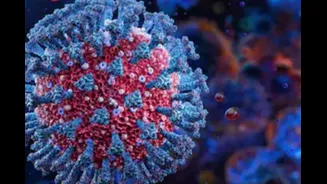







What Exactly Is PJ.2.1?
PJ.2.1 is a new lineage of the SARS-CoV-2 virus, which causes COVID-19. It was first detected in Ontario, Canada, in May 2026 and has since been identified in the United States, Europe, Asia, and Australia. Scientists have labelled it a 'saltation variant',
which means it appeared with a large number of genetic changes at once, rather than evolving slowly over time. This type of variant is thought to develop during a persistent infection in one person before spreading to the wider population. PJ.2.1 is a descendant of the JN.1 family of variants.
Understanding Its Genetic Changes
The primary focus for researchers is the significant number of mutations on PJ.2.1's spike protein. The spike protein is what the virus uses to latch onto and enter human cells via a receptor called ACE2. Laboratory studies have found that PJ.2.1's spike protein seems to bind more strongly and efficiently to this ACE2 receptor compared to some other circulating variants. This enhanced binding ability is one reason the variant is being monitored closely, as it could potentially explain its growth in some regions. However, it's crucial to note that findings in a lab do not always translate directly to real-world transmissibility between people.
No Proof of Increased Danger
The key message from health authorities and researchers is that, at present, there is no clinical evidence to suggest PJ.2.1 causes more severe disease, a higher rate of hospitalisation, or more deaths. While it may be spreading in some areas, a variant can become more prevalent without necessarily making people sicker. The World Health Organization (WHO) is monitoring the variant but has not classified it as a 'variant of concern'. Most healthy adults who are vaccinated or have been previously infected are expected to experience a mild to moderate illness. However, older adults and those with underlying health conditions remain at a higher risk for severe complications from any COVID-19 infection.
Do Vaccines and Treatments Still Work?
Early lab findings offer reassurance regarding vaccine effectiveness. One study found that antibodies from individuals who had received an updated, LP.8.1-adapted vaccine were still able to neutralise the PJ.2.1 variant. The effectiveness was only slightly reduced—by a factor of 1.8—which is a smaller reduction than that seen with several other variants tested. This suggests that PJ.2.1 does not have a dramatic ability to evade the protection offered by current vaccines. Vaccination remains a critical tool for preventing severe disease, especially for those in high-risk groups.
Symptoms to Watch For
There is no unique set of symptoms that can specifically identify a PJ.2.1 infection. The WHO has stated that its symptoms are very similar to those of the common cold, flu, and other recent COVID variants. These can include fever, sore throat, a persistent cough, runny nose, headache, body aches, and fatigue. Since symptoms alone cannot distinguish between respiratory viruses, testing may be required for a definitive diagnosis. Some reports have mentioned the possibility of a more severe sore throat or prolonged fatigue, but this has not been widely confirmed as a specific trait of the variant.