






A Nursery for New Worlds
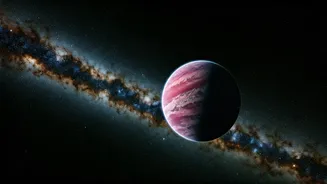
The discovery was made in a star system known as PDS 70, located approximately 370 light-years from Earth. This isn't just any star system; it's a stellar nursery, a place where planets are actively forming right now. At the centre is a young K-type star,
slightly cooler than our Sun, surrounded by a massive swirling cloud of gas and dust known as a protoplanetary disk. This disk is the raw material from which planets are built. The PDS 70 system is particularly special because astronomers have already confirmed the presence of two large, gas-giant planets orbiting within a large gap in this disk. But the latest finding focuses on the area much closer to the star—the inner disk.
Water in the Habitable Zone
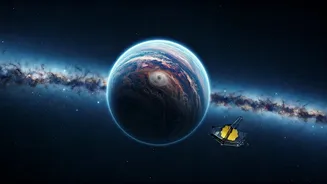
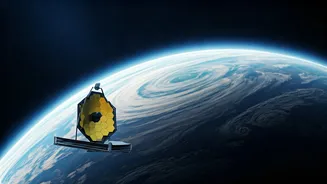
Using its powerful Mid-Infrared Instrument (MIRI), the Webb telescope peered into the inner region of the PDS 70 disk and found the unmistakable chemical signature of water vapour. This is the first time water has been confirmed in the terrestrial planet-forming zone of a disk that is already known to be assembling planets. The water was detected at a distance of less than 160 million kilometres from the star, an orbit that is comparable to the distance between Earth and our Sun. This region is exactly where scientists expect rocky, Earth-like planets to coalesce. The finding was described by lead author Giulia Perotti of the Max Planck Institute for Astronomy as "extremely exciting" because it directly probes the environment where worlds similar to our own could be emerging.
Rewriting the Story of How Planets Form
For decades, one of the biggest questions in planetary science has been: how did Earth get its water? One leading theory suggested that our planet formed dry and was later supplied with water by bombardments from icy asteroids and comets from the outer solar system. This new discovery offers a tantalizing alternative. Finding a significant reservoir of water vapour in the planet-forming zone suggests that terrestrial planets can be born with water from day one. If a rocky planet is currently forming in the inner disk of PDS 70, it has immediate access to this essential ingredient for life as we know it. The discovery was surprising because at 5.4 million years old, the PDS 70 system was thought to be at an age where the harsh radiation from its star would have destroyed any water so close by, leading to a dry environment. This finding challenges that assumption.
Unanswered Questions and a Path Forward
The detection of water raises fascinating new questions. Chief among them is how the water got there and managed to survive. Scientists are exploring two main possibilities. The water molecules could be forming in place, a chemical reaction between hydrogen and oxygen atoms within the hot inner disk. Alternatively, tiny dust particles coated in ice could be migrating inward from the much colder outer disk, crossing the vast gap carved out by the giant planets, and releasing their water as vapour when they get close to the star. Figuring this out will be the next step for astronomers. The team behind the discovery plans to use two other instruments on the Webb telescope, the Near-Infrared Camera (NIRCam) and the Near-Infrared Spectrograph (NIRSpec), to study the PDS 70 system in even greater detail.