


Seeing the Universe in a New Light
To understand infrared astronomy, think about heat. Every object with a temperature, from stars to planets and even the cold dust between them, emits infrared radiation. While our eyes can only see a small slice of the electromagnetic spectrum known as visible
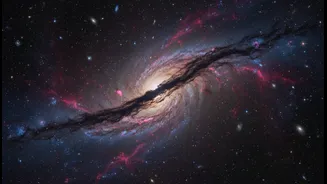
light, infrared light has longer wavelengths that are invisible to us but carry a wealth of information. Because visible light has shorter wavelengths, it easily scatters or gets absorbed by tiny particles of cosmic dust, which act like a thick fog. Infrared light's longer wavelengths can pass straight through these dense clouds, allowing us to see what lies behind them.
Peering into Stellar Nurseries
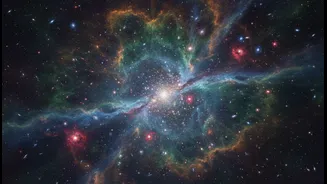
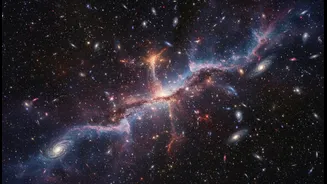
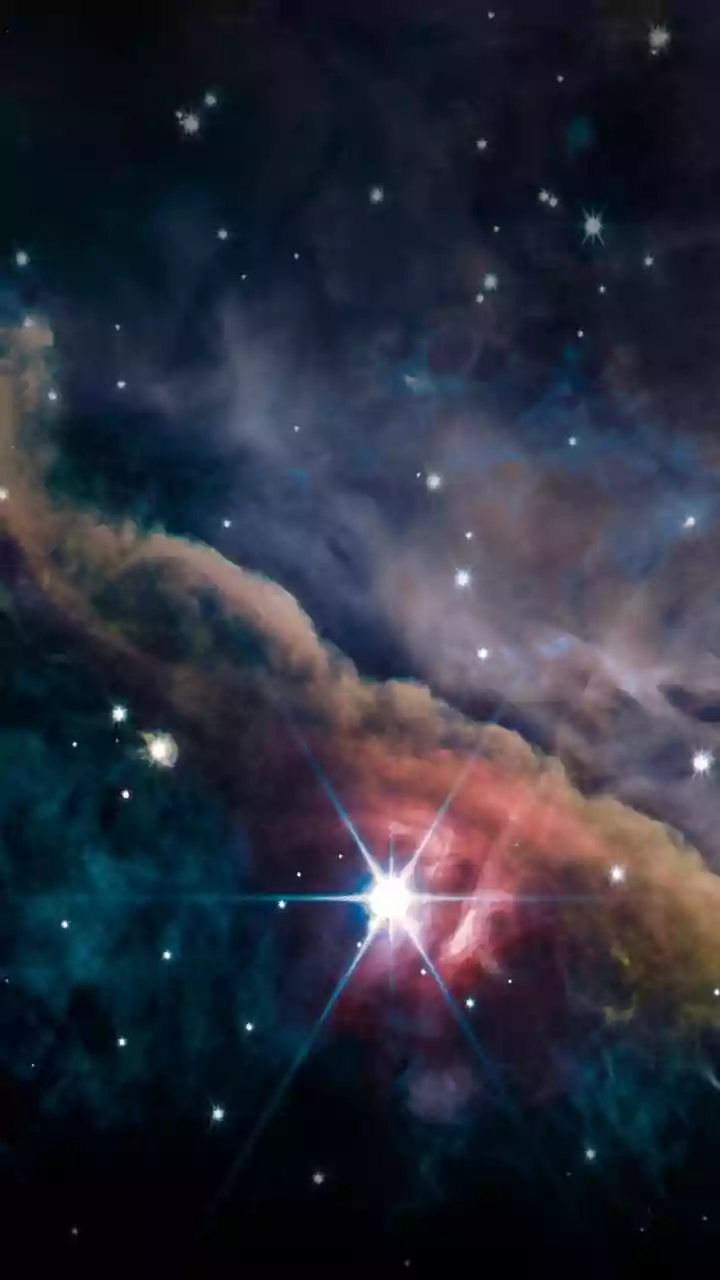
One of infrared astronomy's most powerful abilities is to witness the birth of stars. Stars form inside extremely dense, dusty clouds that are completely opaque in visible light. All the action, from the initial collapse of a gas cloud to the formation of a young protostar, happens deep inside this dusty cocoon. Infrared telescopes can pierce this veil, revealing the faint glow of newborn stars and the heated-up dust surrounding them. This gives scientists a direct view of stellar nurseries, like those in the Orion Nebula, providing crucial insights into how stars, including our own Sun, are formed. Recent images from the James Webb Space Telescope (JWST), for instance, have shown baby stars emerging from their dusty envelopes in unprecedented detail.
Traveling Back to the Dawn of Time
Because light takes time to travel across the vastness of space, looking at distant objects is like looking back in time. The most ancient and distant galaxies are so far away that the light they emitted billions of years ago has been stretched by the expansion of the universe. This phenomenon, known as "cosmological redshift," shifts the light from the visible and ultraviolet part of the spectrum into the infrared. This makes infrared telescopes essential time machines for studying the early universe. Observatories like the JWST are specifically designed to capture this faint, ancient light, allowing astronomers to study the first galaxies that ever formed and piece together the story of cosmic evolution.
Analyzing the Air of Alien Worlds
Infrared light is also a key tool in the search for life beyond Earth. When a planet passes in front of its star, some of the starlight filters through the planet's atmosphere. Different gases in that atmosphere absorb specific wavelengths of light, leaving a unique chemical fingerprint. Many important molecules, including water, methane, and carbon dioxide, absorb infrared light most strongly. By using infrared spectrographs, astronomers can analyze these fingerprints to determine the composition of an exoplanet's atmosphere. The JWST has already used this technique to find evidence of complex organic molecules and even sandy skies on distant worlds, revolutionizing our ability to characterize planets that could potentially harbor life.
The Power of Modern Observatories
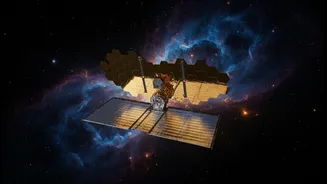
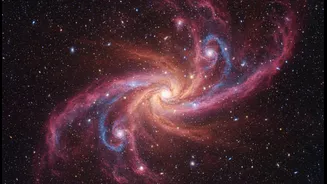
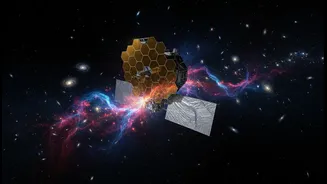
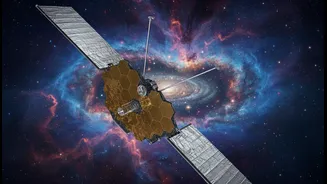
The current golden age of infrared astronomy is powered by incredibly advanced technology. Space telescopes like the James Webb Space Telescope, and its predecessors like the Spitzer and Herschel observatories, have been instrumental. By operating in space, they avoid the interference of Earth's atmosphere, which absorbs much of the infrared radiation from space. The JWST, with its massive mirror and highly sensitive instruments, can capture infrared light with stunning resolution, revealing details that were once impossible to see. As a testament to its power, Webb recently imaged the heart of the Centaurus A galaxy, cutting through dust that blinded the Hubble Space Telescope to reveal a chaotic and beautiful landscape of millions of individual stars shaped by a past galactic collision.