



A Personal, Pressurised World
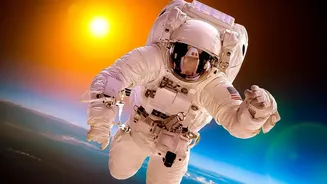
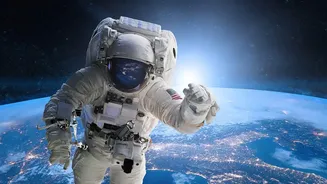
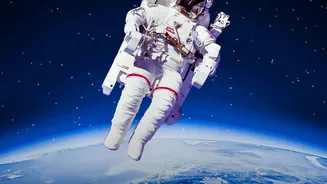
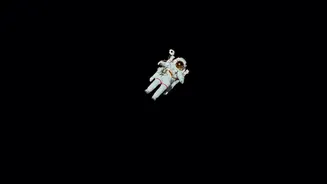
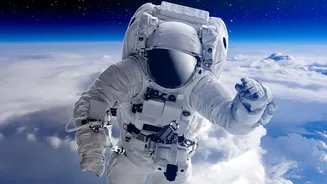
The most immediate threat in space is the lack of air pressure. Without it, human body fluids would essentially boil away. A spacesuit, known formally as an Extravehicular Mobility Unit (EMU), is fundamentally a personal, human-shaped spacecraft designed
to counteract this. It creates a pressurised bubble of pure oxygen, typically around 4.3 pounds per square inch (psi). This is lower than the station's internal pressure, but enough to keep an astronaut alive and provide a breathable atmosphere. To prevent decompression sickness, similar to 'the bends' faced by divers, astronauts must breathe pure oxygen for hours before a spacewalk to purge nitrogen from their bloodstream.
A Multi-Layered Shield
An EMU is not one single garment but a complex assembly of up to 16 layers, each with a critical job. Closest to the skin is the Liquid Cooling and Ventilation Garment, a set of high-tech long underwear laced with about 300 feet of plastic tubing. Cool water flows through these tubes to regulate body temperature and carry away excess heat generated by hard work. Above this lies the pressure bladder, an airtight layer that holds the oxygen, and a restraint layer that prevents the suit from ballooning into a rigid, immovable shape. The outer layers form the Thermal Micrometeoroid Garment, a shield against the harsh environment. Alternating layers of aluminised Mylar provide insulation against temperature swings that can range from a frigid minus 150 degrees Celsius in shadow to a scorching 120 degrees Celsius in direct sunlight. The tough, white outer shell, made of a blend including materials used in bullet-proof vests, provides the final defence against micrometeoroids — tiny particles of rock and debris travelling many times faster than a bullet.
Life Support in a Backpack
All the systems needed to stay alive are housed in the Primary Life Support System (PLSS), the backpack an astronaut wears. This unit contains the oxygen tanks, batteries to power the suit's electronics, a fan to circulate air, and a carbon dioxide removal system. It also holds the water for the cooling garment and the communications radio that links the astronaut to their crewmates and Mission Control. In case of an emergency where an astronaut becomes untethered, a nitrogen-propelled jetpack called SAFER (Simplified Aid for EVA Rescue) is attached to the backpack, allowing them to fly back to safety.
The Challenge of Getting Work Done
Simply surviving isn't enough; the suit must allow an astronaut to perform complex repair tasks. This is perhaps its greatest challenge. The pressurised suit is stiff, and every movement requires fighting against that internal pressure. The gloves are particularly difficult, often described as trying to work inside stiff, inflated balloons. This leads to extreme hand fatigue, bruising, and even fingernail injuries over the course of a six- to eight-hour spacewalk. To overcome this, many tools used for space repairs are specially designed with large, easy-to-grip handles and mechanisms that can be operated by astronauts with limited dexterity. Some repairs are for equipment that was never even designed to be serviced in orbit, making the tasks even more complex for the crew.
The Future of Spacewalks
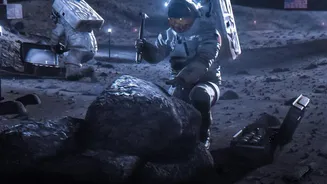
The current EMU design has been a workhorse of space exploration for decades, first used in 1983. However, as NASA plans for missions back to the Moon and eventually to Mars, a new generation of suits is under development. NASA's Exploration Extravehicular Activity Services (xEVAS) program is contracting with commercial companies like Axiom Space to build these new systems. These future suits, like the Axiom AxEMU, aim to be more flexible, offer greater mobility for walking on planetary surfaces, and incorporate advanced technologies for a new era of exploration. Until they are ready, the venerable EMU continues to be the essential tool that makes work outside the spacecraft possible.