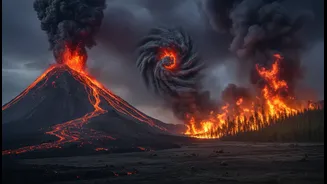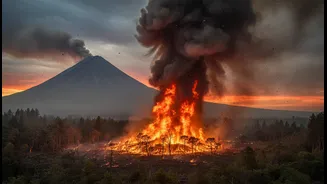




Volcanoes: Earth's Sun Reflector
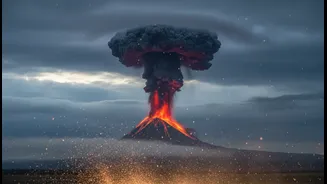
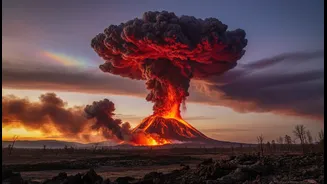
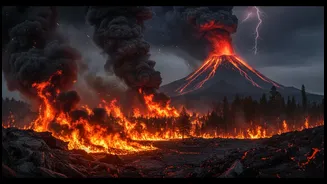
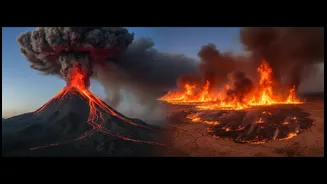
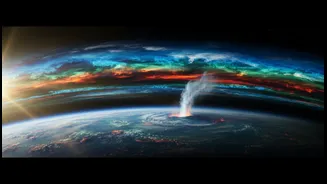
When a major volcano erupts, it can inject a massive cloud of particles and gases into the stratosphere, the atmosphere's second layer. While the heavy ash falls out relatively quickly, the key climate actor is sulfur dioxide (SO2). High in the atmosphere,
SO2 converts into sulfuric acid aerosols, which are highly reflective. This fine mist acts like a planetary sunshade, scattering incoming solar radiation back into space and causing a temporary cooling of the Earth's surface. The 1991 eruption of Mount Pinatubo, for instance, injected about 20 million tons of SO2 into the stratosphere and cooled the planet by as much as 1.3 degrees Fahrenheit for up to three years. While volcanoes do release carbon dioxide, a greenhouse gas, the amounts are minuscule compared to human activities—less than one percent of what we emit annually. For this reason, their dominant modern climate impact is short-term cooling.
Wildfires: A Vicious Warming Cycle
Wildfires operate on a different principle. Instead of acting as a sunshade, they primarily contribute to warming. Fires release vast quantities of stored carbon from trees and soil back into the atmosphere as carbon dioxide. This adds to the blanket of greenhouse gases trapping heat. But it’s not just CO2. Wildfires also emit black carbon, or soot, a potent warming agent that absorbs sunlight both in the atmosphere and when it settles on snow and ice, reducing their reflectivity. Unlike the carbon released from burning fossil fuels, the CO2 from wildfires is part of a natural cycle. However, climate change is disrupting this balance. Hotter, drier conditions are leading to more frequent and intense fires, which in turn release more greenhouse gases, creating a dangerous feedback loop that accelerates warming.
Cooling vs. Warming: The Key Distinction
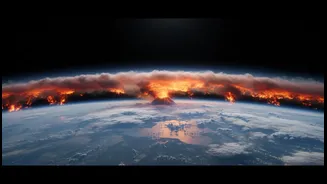
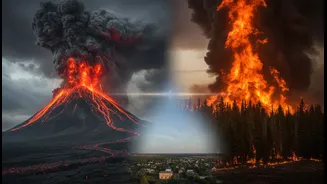
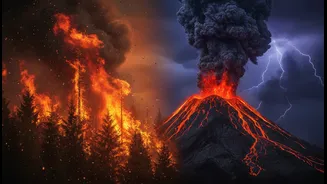
The simplest way to separate the two is to think in terms of warming and cooling. Large volcanic eruptions are a net cooling force. The sulfur dioxide they emit reflects sunlight so effectively that it temporarily overshadows the warming effect of their CO2 emissions. Wildfires, on the other hand, are a net warming force. They release huge amounts of CO2 and other warming agents like black carbon. While some smoke particles can have a minor, temporary cooling effect by blocking sunlight regionally, this is vastly outweighed by the overall contribution to the greenhouse effect. So, while both are visually dramatic, their primary impacts on global temperature are opposites.
Timeline, Scale, and Human Influence
Duration is another critical difference. The global cooling from a major volcanic eruption is intense but brief, typically lasting one to three years before the aerosols fall out of the stratosphere. Wildfire emissions, however, contribute to the long-term accumulation of CO2 in the atmosphere, which has a warming effect that lasts for a century or more. Furthermore, the scale of emissions differs drastically. All the world's volcanoes combined emit less than one percent of the CO2 that humans release each year. In contrast, worsening fire seasons, exacerbated by climate change, are becoming a more significant part of the annual global emissions equation. While volcanic eruptions are a purely natural force, wildfire frequency and intensity are now heavily influenced by human-caused climate change creating hotter and drier conditions.