


Step 1: Gather Your Essential Gear
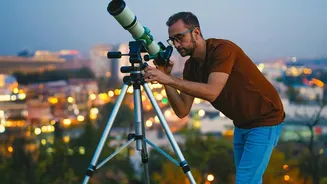
You don't need a space telescope to get started, but a few items are non-negotiable. First, you need a camera that allows manual control, like a DSLR or mirrorless camera. Second, a telephoto lens is crucial; something in the 200mm to 500mm range will
start to reveal the Moon's surface details. Third, and most importantly, is a sturdy tripod. The slightest vibration is magnified at long focal lengths, so stability is key to a sharp image. A remote shutter release or using your camera's built-in two-second timer is also highly recommended to prevent camera shake when you press the button.
Step 2: Plan Your Target and Location
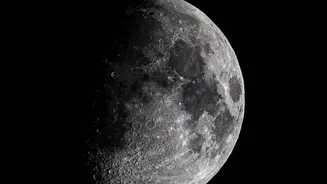
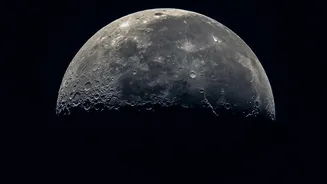
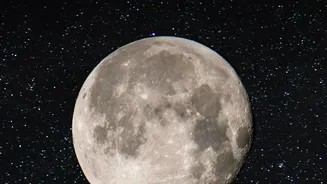
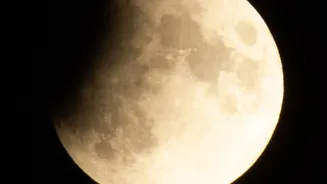
Poor planning is a common mistake that can ruin a session before it starts. For your first night, your target should be the Moon. It's bright, easy to find, and its details are rewarding to capture. Planets like Jupiter and Saturn are also great targets, but appear much smaller and require more magnification. Use a stargazing app to see what's visible and when. Pick a setup spot with a clear view, ideally away from the direct glare of streetlights. While dark skies are always better, the Moon is bright enough to be photographed even from a city backyard.
Step 3: Dial in Your Starting Camera Settings
Switch your camera to Manual (M) mode. This gives you full control. For the Moon, you might be surprised to learn that you need settings similar to a daytime shot, because the sunlit surface is incredibly bright. A good starting point is the 'Looney 11' rule: an aperture of f/11, and a shutter speed that is the inverse of your ISO. Try setting your ISO to 100, your aperture to f/11, and your shutter speed to 1/100 or 1/125 of a second. These are just starting points; you will adjust them based on your results.
Step 4: Master the Manual Focus
Autofocus systems will almost always fail against the dark sky. Getting a sharp manual focus is perhaps the most critical—and frustrating—step for beginners. The best method is to use your camera’s 'Live View' function on the rear screen. Point your camera at the Moon (or the brightest star or planet you can find) and digitally magnify the view as much as possible, usually 5x or 10x. Then, very carefully turn your lens's focus ring until the edge of the Moon or the star becomes a tiny, sharp point of light. Once you have it, don't touch the focus ring again.
Step 5: Take the Shot (and Many More)
With your camera stable and focused, it's time to shoot. Use your remote shutter or the camera's timer to take the picture. This prevents any jiggle from your hand. Your first shot will probably not be perfect. Check the image on your camera's screen. Is it too bright? Increase your shutter speed (e.g., from 1/125s to 1/250s). Too dark? Decrease the shutter speed. Don't be afraid to experiment. Take lots of photos with slightly different settings. This practice of 'bracketing' your exposures gives you more options later.
Step 6: A Note on Photographing Planets
While the Moon is a solo object, planets present a different challenge. They are bright but very small. With a standard telephoto lens, they will likely appear as bright, star-like dots, which can still be beautiful, especially when captured near other celestial objects. To get surface detail on planets like Jupiter or Saturn, photographers often use a technique called 'lucky imaging', which involves taking a video and stacking the clearest frames. For your first night, focus on just capturing them as sharp points of light using similar settings to bright stars: a wide aperture, a higher ISO (like 800-1600), and a shutter speed under 20 seconds to avoid star trails.
Step 7: Manage Expectations and Celebrate the Win
Your first night is about learning the process, not capturing an award-winning photo. It's easy to get frustrated if your images don't look like the polished ones you see online. Remember that many of those are the result of advanced techniques and hours of editing. The goal tonight is to successfully set up your gear, achieve a sharp focus, and capture a recognizable image of a celestial body. Getting a clear shot of lunar craters or seeing the moons of Jupiter as tiny dots next to the planet is a huge accomplishment. Enjoy the process and the quiet of the night sky.