





Your New Digital Study Partner
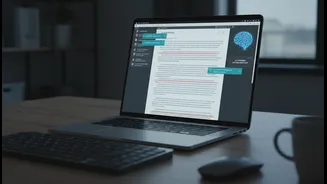
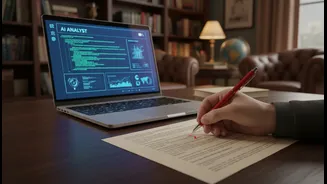
Forget basic spell-checkers and grammar apps. The latest AI writing assistants function more like a critical friend or a tutor, offering sophisticated feedback on your work. These tools go beyond surface-level corrections to analyse the core components
of your draft. They can assess the flow of your arguments, check for coherence between paragraphs, and ensure that your entire paper supports your main thesis. Students are increasingly using these tools for a range of tasks, from brainstorming ideas and finding evidence to polishing their final drafts. The goal is not to replace the student's thinking but to provide a new layer of feedback that helps them see their own work more clearly, much like a peer review.
From a Jumble of Ideas to a Coherent Argument
The single biggest challenge in academic writing is often not the research itself, but organising it into a logical and persuasive structure. AI draft analysis tools are specifically designed to help with this. They can break down a paper to check if each section has a clear purpose and if topic sentences align with the overall argument. Some tools can even create visual maps of your paper's structure, highlighting areas where the logical flow breaks down or where connections between ideas are weak. By pointing out gaps in reasoning or sections that need more supporting evidence, these tools prompt students to think more critically about how they are presenting their information. This transforms the AI from a simple editor into a partner in the thinking process.
The Fine Line Between a Tool and Cheating
The rise of powerful AI has understandably sparked a major debate about academic integrity. Where is the line between using an AI assistant and committing plagiarism? The answer lies in intent and transparency. Using an AI to refine your grammar, check your structure, or suggest clearer phrasing for your own original ideas is generally seen as an acceptable use of technology. However, using it to generate entire paragraphs or the core intellectual arguments of your paper is academic misconduct. Many universities in India are still developing formal policies, but guidelines from bodies like the University Grants Commission (UGC) emphasize that students bear full responsibility for the originality and accuracy of their work. Non-disclosure of AI assistance is often considered a violation of academic ethics.
Navigating the Risks: Hallucinations and Bias
While powerful, AI tools are not infallible. One of the biggest risks is what experts call "hallucination," where an AI confidently states false information or invents fake sources. Relying on AI for factual content without independent verification can severely undermine the credibility of your research. Furthermore, because these models are trained on vast amounts of existing text, they can sometimes reproduce hidden biases related to language or culture. Students must therefore act as the final authority, critically evaluating every suggestion the AI makes. Think of it as an assistant, not an author; its job is to provide suggestions, but your job is to approve, reject, and verify them.
Best Practices for Using AI Responsibly
To get the most out of AI draft analysis without crossing ethical lines, students should follow a few key principles. First, always check your institution's specific policy on AI use. Second, use AI tools in the later stages of writing, for refinement and review, rather than for initial drafting. Your core ideas and arguments must be your own. Third, always disclose your use of AI tools in your work, usually in an acknowledgements section, as per emerging academic standards. Finally, treat the AI's feedback as suggestions, not commands. The goal is to improve your own writing and critical thinking skills, not to outsource them. By using these tools wisely, you can make them a valuable asset in your academic journey.