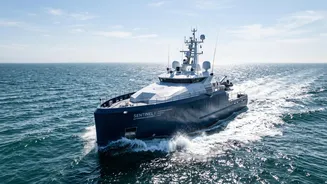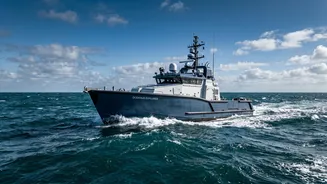


The age of autonomous shipping is approaching, promising a revolution in global trade. But before crewless vessels can navigate the high seas, they face a critical test: safety. IIT Madras has an answer with its new platform, SeaNav.
The High-Stakes World of Maritime Testing
The global shipping
industry is the backbone of world trade, carrying over 80% of goods across the planet. The move towards autonomous vessels—ships that can navigate without a human crew—promises to make this system safer and more efficient. However, there is a fundamental challenge: how do you test a self-driving ship? Unlike a car, a large vessel cannot simply pull over if something goes wrong. Real-world trials are incredibly expensive, complex, and carry significant risks to the vessel, cargo, and the marine environment. Any accident could be catastrophic, far exceeding the scale of incidents seen with driverless cars. This testing hurdle has been a major barrier to the widespread adoption of autonomous maritime technology, requiring a solution that can prove a system's reliability before it ever touches water.
Enter SeaNav: A Virtual Proving Ground
Researchers at the Indian Institute of Technology Madras have developed an innovative solution called SeaNav. Developed by the Department of Ocean Engineering, SeaNav is a real-time 'digital twin' platform designed specifically to test, validate, and train autonomous maritime navigation systems. In simple terms, it is a highly realistic virtual world for ships. This platform addresses the testing challenge head-on by creating a high-fidelity simulated environment where everything from ocean conditions and vessel traffic to complex port approaches can be replicated. Instead of risky and costly physical tests, navigation algorithms can be pushed to their limits in a completely safe, controlled, and digital space. This breakthrough comes from one of India's 'Institutes of Eminence,' aligning with national goals like the Sagarmala Programme and Maritime India Vision 2030, which focus on modernising India's ports and maritime sector.
How the Digital Twin Technology Works
At its core, SeaNav is a digital twin—a virtual replica of a physical asset that is updated with real-time data. Built on the Unity3D engine, the platform creates a detailed model of the maritime world, capable of simulating ocean waves, vessel movements, and complex navigation scenarios with remarkable accuracy. The system has been calibrated using a 320-meter benchmark tanker vessel, ensuring that the results from the virtual tests closely mirror real-world performance. What makes SeaNav particularly powerful is its ability to simulate realistic sensor limitations. Unlike perfect simulators, it introduces factors like signal noise and delays for systems like GPS, radar, and cameras, forcing the autonomous navigation AI to perform in challenging conditions like fog and rain. This creates a much tougher, and therefore more reliable, testing standard.
More Than Just a Simulator
The applications for SeaNav extend far beyond just testing AI. It serves as a powerful training tool for human operators as well. Using immersive Virtual Reality (VR) headsets, maritime professionals can experience the simulation from the ship's bridge, allowing them to practice emergency responses, collision avoidance, and complex manoeuvres without any physical risk. Furthermore, its multi_vessel simulation capabilities make it a valuable asset for planning coastal surveillance, coordinating search_and_rescue operations, and even for maritime defence applications. According to Dr. Suresh Rajendran, Associate Professor at IIT Madras, the platform's goal is to create an environment where both autonomous systems and human operators can be trained safely and efficiently before deployment.
Paving the Way for India's Maritime Future
The development of SeaNav is a significant step forward for India's technological and maritime ambitions. It provides a scalable platform for developing and validating the next generation of navigation technologies. By creating AI_assisted navigation systems, it can help reduce the risk of collisions and grounding at major Indian ports, including Chennai, Mumbai, Visakhapatnam, and Kochi. This home_grown technology not only supports the 'Make in India' initiative but also positions the country as a key innovator in the global push towards autonomous shipping. The work being done at IIT Madras's Centre of Excellence for Vessels and Unmanned Systems is helping to build a future where India develops its own maritime technology rather than relying on foreign expertise, potentially becoming a global hub for the sector.