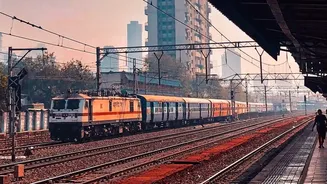







The Familiar Festive Nightmare
Every year, during festivals like Diwali and Chhath Puja, a predictable pattern emerges. Train tickets on popular routes connecting major cities to hometowns vanish within minutes of the booking window opening, often 120 days in advance. Millions of hopeful
travellers are left staring at long waitlists—GNWL, RLWL, PQWL—and the dreaded 'REGRET/WL' status, which means no more bookings are allowed. This leaves families scrambling for last-minute, often expensive, alternatives or facing the possibility of cancelling their trip altogether. The demand simply overwhelms the supply, especially on corridors to Uttar Pradesh and Bihar, turning the dream of a festive family reunion into a logistical nightmare.
Thinking Outside the Direct Route
When a direct train from your origin to destination is fully booked, the solution is to think in segments. This is the core of a 'connecting journey' or 'break journey' strategy. Instead of searching for a single ticket from Mumbai to Patna, you might book one ticket from Mumbai to a major intermediate junction like Kanpur or Prayagraj, and a second ticket from that junction to Patna. This approach works because Indian Railways allocates seat quotas to various stations along a route. While the quota for the full journey might be exhausted, smaller quotas for intermediate legs of the journey may still have availability. By splitting your trip, you are essentially tapping into these underutilised seat pools, dramatically increasing your chances of finding a confirmed berth.
Using IRCTC's 'Connecting Journey Booking' Tool
Manually booking two separate tickets carries a significant risk: if your first train is delayed, you could miss your second one and lose the money for that ticket. To address this, IRCTC offers an official feature called 'Connecting Journey Booking'. This tool allows you to link two PNRs during the booking process itself. You book your first ticket (which must be confirmed or RAC), and then use that PNR to book the second leg of your journey through the 'Connecting Journey' option on the IRCTC website or app. The primary benefit is protection: if the first train's delay causes you to miss the second, you are entitled to a full refund of the base fare for the missed portion, provided you file a Ticket Deposit Receipt (TDR) within three hours of the first train's actual arrival.
A Step-by-Step Guide to Linking PNRs
Booking a linked journey is a straightforward process. First, book your initial train and ensure it has a 'Confirmed' or 'RAC' status. Once you have this PNR, log into your IRCTC account and navigate to the 'Trains' menu, where you will find the 'Connecting Journey Booking' option. Enter the PNR of your first journey. The system will validate it and auto-populate passenger details for the next booking. Then, search for your second train. For the connection to be valid, the terminating station of the first train must be the same as the boarding station for the second. Passenger details must also match exactly across both tickets. It's crucial to remember that you cannot link two PNRs after both have been booked independently; the linking must happen while booking the second ticket.
Planning for a Smooth Transfer
While the system allows a minimum connection time of just one minute, a smart traveller plans for reality. Indian Railways trains can face unforeseen delays. To avoid a frantic dash across platforms, it is wise to plan a generous layover—at least three to four hours—between the scheduled arrival of your first train and the departure of the second. This buffer absorbs the impact of most routine delays. Use the layover time productively. Major railway junctions are equipped with waiting rooms, food courts, and other amenities where you can rest and refresh before the next leg of your journey. A well-planned layover turns a potential point of stress into a comfortable break.
Weighing the Risks and Rewards
The single greatest reward of a connecting journey is securing a confirmed ticket when all other options have failed. It gives you control in a seemingly impossible situation. However, the strategy requires careful planning. The main risks are managing your luggage during the transfer and the inherent possibility of miscalculating the layover time, even with the refund protection. Furthermore, not all routes will have convenient connections, and finding two trains with suitable timings can take some research. But for many, the extra effort is a small price to pay for the assurance of reaching home for the holidays. It's a calculated move that transforms you from a passive waiter on a long list to an active planner who has found a way home.