





In the vast, dark expanses of our galaxy, countless strange objects drift alone. Now, NASA’s SPHEREx telescope is peeling back the darkness on some of the most mysterious: 'failed stars' with atmospheres containing both water and methane.
Meet SPHEREx, The Cosmic Mapper
Launched in March
2025, NASA's SPHEREx space telescope is on a grand mission. Its full name—Spectro-Photometer for the History of the Universe, Epoch of Reionization, and Ices Explorer—hints at its ambitious goals. The telescope is designed to scan the entire sky in near-infrared light, which is invisible to the human eye but perfect for answering cosmic questions. Over its two-year mission, SPHEREx will create four complete maps of the sky, gathering data on hundreds of millions of galaxies and stars. It does this using spectroscopy, a technique that breaks down light into its component colors, revealing the chemical makeup of distant objects. While its main goals involve studying the origins of the universe and galaxies, this powerful survey capability has made it an exceptional tool for an unexpected side project: hunting for brown dwarfs.
What Are 'Failed Stars'?
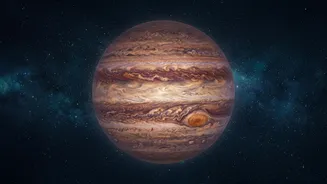
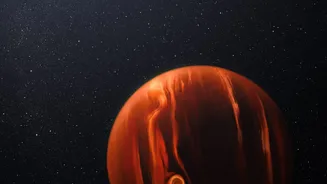
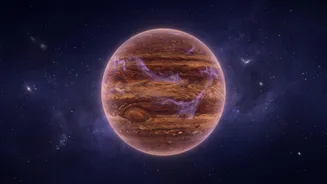
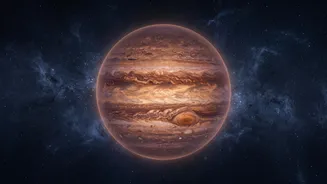
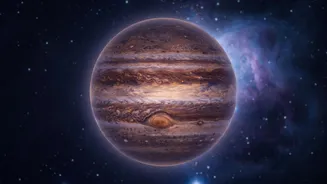
Brown dwarfs are the universe's fascinating in-betweeners, blurring the line between a giant planet like Jupiter and a small star. They form from collapsing clouds of gas and dust, just like stars do. However, they never accumulate enough mass—the threshold is about 80 times the mass of Jupiter—to kickstart the sustained hydrogen fusion in their cores that makes stars shine. This is why they're often called 'failed stars'. Despite this moniker, they are far more massive than any planet in our solar system. Instead of being powered by fusion, they dimly glow from the leftover heat of their formation, slowly cooling and fading over billions of years. Many of them drift through space alone, not orbiting a parent star, making them difficult to spot.
Water and Methane in the Dark
The latest findings, detailed in The Astrophysical Journal, come from SPHEREx's analysis of 37 nearby brown dwarfs. By studying their spectra, scientists have confirmed the presence of chemically rich atmospheres containing water (H2O), methane (CH4), carbon monoxide (CO), and carbon dioxide (CO2). Finding these molecules isn't entirely a surprise, as some had been detected before on individual brown dwarfs. What makes the SPHEREx data so powerful is its ability to observe a large population of these objects across a wide range of temperatures, from a scorching 2,200 degrees Celsius down to a frigid minus 20 Celsius. This allows scientists to see how their atmospheric chemistry changes as they age and cool. As one scientist noted, they've become 'accidental meteorologists' for these strange worlds.
Why This Discovery Matters
Detecting water and methane, molecules we associate with life on Earth, doesn't mean these failed stars are habitable. Their environments are incredibly harsh. However, the discovery is crucial for understanding the bigger picture of cosmic formation. Brown dwarf atmospheres are like simplified, standalone laboratories for studying the physics and chemistry that also occur on gas giants, both in our solar system and around other stars. Because brown dwarfs aren't blinded by the light of a nearby star, their atmospheres are easier to study than those of exoplanets. The SPHEREx data reveals how clouds of exotic materials like silicate and iron form and then sink, allowing molecules like methane to become dominant in the atmosphere as the object cools. This provides a real-world test for computer models of planetary and stellar atmospheres, and early results show that while the models get the broad strokes right, they struggle to explain the fine details, proving these 'goth' worlds are even more complex than we imagined.