





The Universe’s Invisible Glue
For decades, physicists have been confronted with a massive problem—literally. When they observe galaxies, they see them spinning so fast that, based on the visible matter we can detect, they should fly apart. The only way they hold together is if there
is some invisible 'cosmic glue' providing extra gravitational pull. This mysterious substance, which neither emits nor reflects light, is known as dark matter. Scientists are certain it exists because of its immense gravitational effects, but it has never been directly observed. It’s believed to account for the vast majority of matter in the cosmos, yet its true nature remains one of the biggest unanswered questions in modern physics. This gap in our knowledge has prompted a search for new physics beyond our current understanding.
Thinking Beyond Our Three Dimensions
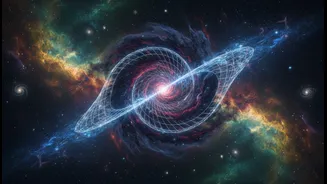
Our everyday experience is in three spatial dimensions (length, width, and height) plus one dimension of time. But for over a century, physicists have toyed with the idea that more dimensions might exist, just hidden from our perception. The concept, first proposed to unify gravity with electromagnetism, suggests that an extra dimension could be rolled up incredibly tightly, too small for us to see or interact with. More modern ideas, like the 'warped extra dimension' (WED) model proposed by physicists Lisa Randall and Raman Sundrum in 1999, imagine our universe as a 'brane' floating in a higher-dimensional space. In this view, most of the particles and forces we know are stuck to our brane, while others, like gravity, might be able to travel across the extra dimension.
A 'Resonance' in a Hidden Dimension
So where does dark matter fit in? A recent theory from physicists at the University of Sheffield proposes a compelling answer. They suggest that dark matter particles, along with a hypothetical 'dark photon,' reside in this hidden fifth dimension. The theory's elegance comes from its natural explanation for a phenomenon called 'dark matter resonance,' which is loosely similar to how a musical instrument vibrates intensely when it hits the perfect note. According to their study, the specific geometry of this fifth dimension could naturally cause the masses of dark matter particles to line up in a precise way that creates this resonance. This could explain why dark matter might have interacted strongly in the early universe but is so inert and difficult to detect today.
Elegant Maths, Elusive Proof
The mathematical beauty of this new model is that this 'perfect tuning' is not an artificial add-on but emerges naturally from the structure of the hidden dimension itself. Previous theories often required physicists to meticulously 'arrange by hand' the values for particle masses to make the physics work. This new model avoids that, providing what scientists call a more 'natural' solution. However, the headline's central tension remains: there is no direct proof. The theory is compelling on paper, but how could we ever detect particles in another dimension? Some scientists believe future, highly sensitive gravitational wave detectors might be able to sense signals from such hidden realms. Until then, the fifth dimension remains a tantalising but theoretical possibility.
Why Pursue Unprovable Ideas?
This raises a fundamental question: why do scientists invest so much effort into theories that are so difficult, if not impossible, to prove? The answer lies at the heart of scientific progress. These 'what if' scenarios push the boundaries of knowledge. By connecting two of the biggest ideas in physics—the mystery of dark matter and the existence of hidden dimensions—this research gives physicists new targets in their search. It provides a new framework and suggests what kind of signals to look for. Moreover, the quest itself drives innovation. The ultra-sensitive technologies developed to hunt for dark matter have practical applications in medicine, computing, and communications, proving that even a search for the invisible can lead to tangible benefits in our world.