
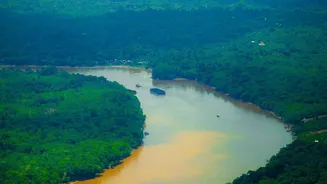

The Grand Vision on Water
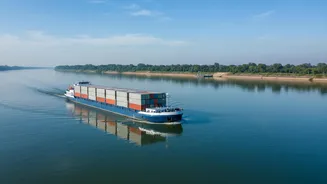
The National Waterways Act of 2016 laid the groundwork for one of India's most ambitious infrastructure projects. The goal is to develop a vast network of navigable rivers and canals to transport cargo, aiming to reduce the country's high logistics costs,
which are a significant percentage of GDP. Proponents argue that shifting cargo from congested roads and railways to water is not only cheaper but also significantly more fuel-efficient and environmentally friendly. Initiatives like the Jal Marg Vikas Project (JMVP) on National Waterway-1 (the Ganga river) are meant to be the blueprint, aiming to increase cargo movement and unlock economic growth in India's landlocked eastern states. The government's vision is to increase the share of waterway transport from its current low single-digit percentage to be a major pillar of the nation's logistics network.
Why A Waterway is More Than a River
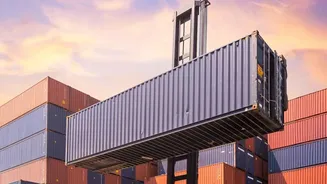
A navigable river is only one part of the equation. For a waterway to function as a commercial artery, it needs effective points to get goods on and off the water. This is where terminals come in. These range from large, multi-modal terminals designed to handle massive volumes of cargo with connections to rail and road, to smaller, community-focused jetties. Under the plan, major terminals have been built at strategic locations like Varanasi, Sahibganj, and Haldia. The idea is to create a seamless network where a container can be loaded onto a barge, travel hundreds of kilometres on the river, and then be efficiently transferred to a truck or train for its final destination. Without this seamlessness, the entire system breaks down.
The Last-Mile Bottleneck
This is the crux of the problem. While gleaming new terminals have been inaugurated, their value is often compromised by what lies beyond their gates: the last-mile connectivity. A parliamentary committee report highlighted that poor hinterland connectivity is one of the key factors discouraging companies from shifting to waterways. A terminal may be state-of-the-art, but if the road leading to it is a narrow, broken path unable to handle heavy trucks, it creates a massive bottleneck. The cost and time saved on the water are quickly lost on the land. This challenge involves not just building roads but ensuring they are integrated with the national highway system and that there are rail sidings where necessary. It's an issue of holistic planning, requiring coordination between the ministries of shipping, road transport, and railways.
A Chain Is Only As Strong As Its Weakest Link
The logistics industry operates on efficiency and predictability. A company shipping goods from a factory to a port needs to know the total time and cost. While water transport is cheap, if the first and last mile legs are expensive, slow, and unreliable, the overall cost advantage disappears. This is the reality facing many of the new terminals. Reports indicate that traffic at some key terminals has been far below initial projections. Private sector participation, crucial for providing shipping services, has been sluggish, partly due to the uncertainty around this end-to-end connectivity and the lack of return-journey cargo. Without a critical mass of users, the waterway ecosystem struggles to become self-sustaining.
Is Progress Being Made?
The government is aware of these challenges and is taking steps to address them. The PM Gati Shakti framework is designed to break down silos between ministries and promote integrated infrastructure planning. The focus is shifting from simply building terminals to ensuring they are true multi-modal hubs from the project planning stage itself. The Arth Ganga program, an extension of the JMVP, aims to develop local logistics and community jetties to support livelihoods along the river, creating a more organic economic ecosystem. However, significant hurdles remain. Land acquisition for access roads and other supporting infrastructure is a slow process, and fully operationalising all the built assets has proven difficult due to limited market competition and sector maturity. The success of India's waterways will depend on a sustained, ground-level focus on fixing these vital connections.