

The Rise of the Smart Telescope
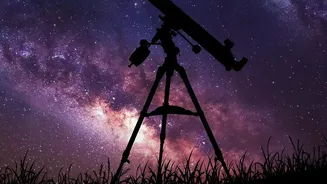
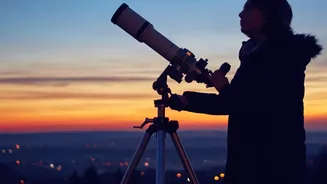
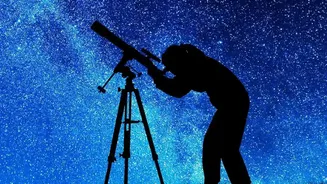
Not long ago, serious deep-sky astrophotography required a cumbersome setup and deep expertise. Today, a new class of 'smart telescopes' has transformed the experience. These devices, controlled by a smartphone or tablet app, automate the most challenging
parts of the process. After a simple setup, a user can select a galaxy or nebula from a menu, and the telescope will automatically point to it, track it, and begin capturing images. This is made possible by a technology called plate solving. The telescope takes a quick photo of its location, analyzes the star patterns against a database, and instantly knows exactly where it's pointing, allowing for incredible accuracy without manual star-hopping. This automation means less time wrestling with equipment and more time capturing the cosmos, even for beginners.
More Sensitive Eyes on the Sky
At the heart of any astrophotography rig is the camera, and recent advancements have been a game-changer. For decades, serious amateurs relied on cooled CCD (Charge-Coupled Device) cameras, which were effective but expensive and slow. Now, a different technology, CMOS (Complementary Metal-Oxide-Semiconductor) sensors, has taken over. Modern back-illuminated CMOS cameras are incredibly sensitive to faint light, have much lower noise, and can read out images faster than their CCD counterparts. This high sensitivity and low noise mean that photographers can take shorter exposures, which simplifies tracking and reduces the chances of a passing satellite ruining a long shot. The affordability and performance of CMOS cameras have put professional-grade imaging capabilities into the hands of hobbyists.
The Unsung Hero: A Smarter Mount
A telescope and camera are only as good as the mount they sit on. To capture faint objects millions of light-years away, the mount must counteract the Earth's rotation perfectly, keeping the target locked in the same position for hours. Modern computerized equatorial mounts are the key. These 'GoTo' mounts contain databases of thousands of celestial objects and can automatically point the telescope with high precision. When combined with autoguiding—where a second small camera and scope lock onto a single star and make tiny corrections—these mounts achieve the tracking accuracy needed for long-exposure deep-sky imaging. This level of automation was once the domain of professional observatories but is now a standard feature for serious amateurs.
Software: The Digital Darkroom
The final magic happens not in the telescope, but on the computer. A single photo of a distant galaxy is often faint and noisy. To create a vibrant, detailed final image, photographers use a technique called stacking. Software like DeepSkyStacker, Siril, or the more advanced PixInsight takes hundreds or even thousands of individual images and aligns them perfectly. This process averages out random noise, enhancing the faint signal from the deep-sky object. The result is a 'master' image with a much cleaner and deeper view of the target. Further processing then helps to bring out color, contrast, and fine details, turning a collection of noisy, monochrome frames into a spectacular portrait of the universe.
Powering It All, Anywhere
The 'remote location' aspect is critical for astrophotography, as escaping city light pollution is the number one priority for seeing faint objects. This new generation of gear is not only powerful but also increasingly portable. Running a computerized mount, a cooled camera, a laptop or mini-PC, and dew heaters requires a reliable source of electricity for an entire night. The development of high-capacity, portable power stations has been essential. These battery packs can power a complete astrophotography rig for eight hours or more, are silent, and can often be recharged with solar panels for multi-night trips, truly untethering photographers from the grid and allowing them to set up under the darkest skies.