



The Cosmic Commute
We think of sunlight as a simple switch: the sun is up, and it’s bright. But the light that makes your tea sparkle and illuminates the dust motes in the air isn't just 'on'. It’s a physical thing that has travelled an immense distance to get to you. Every
single particle of light, or photon, that lands on your skin began its journey millions of kilometres away, shooting out from the fiery surface of our star. It then sped through the vacuum of space on a solo mission with a single destination: somewhere in our planet’s neighbourhood. It’s not an instantaneous event; it’s a journey with a beginning, a middle, and an end. And that journey takes time.
The Universe's Speed Limit
The reason for this delay is the universal speed limit, better known as the speed of light. In the vast emptiness of space, light travels at an almost incomprehensible pace: approximately 3,00,000 kilometres per second. To put that in perspective, a beam of light could circle the Earth more than seven times in a single second. Nothing with mass can travel this fast, and nothing at all can travel faster. It’s the absolute, unbreakable traffic law of the cosmos. Every ray of sunshine, every twinkle from a distant star, and every signal from a deep-space probe is bound by this constant. This cosmic speed limit is what makes the time delay not just possible, but inevitable.
Doing the Simple Cosmic Math
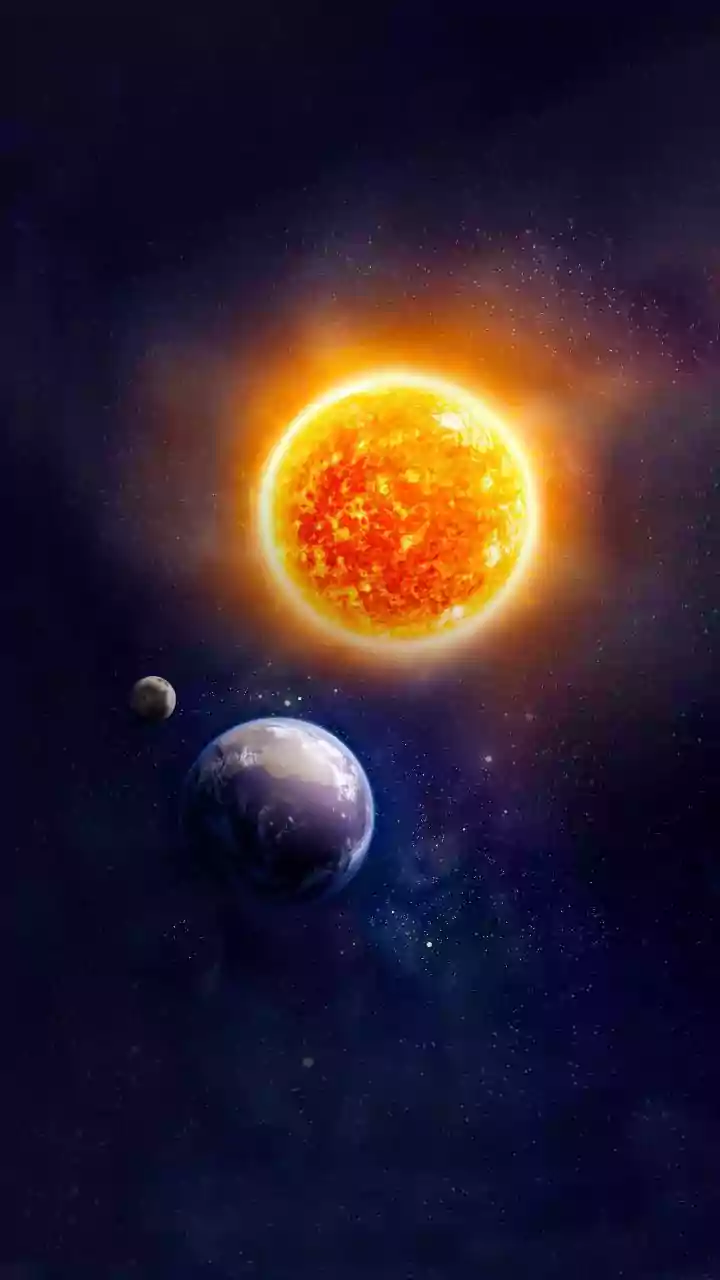
So how do we get to exactly eight minutes and twenty seconds? The calculation is surprisingly straightforward. The Earth orbits the Sun at an average distance of about 150 million kilometres. If you divide that vast distance by the speed of light (3,00,000 km/s), you get a travel time of 500 seconds. Convert those seconds into minutes, and you arrive at eight minutes and twenty seconds. Now, it’s important to note this is an average. The Earth’s orbit is not a perfect circle; it’s a slight ellipse. At its closest point (perihelion), in early January, we are about 147 million km away, and sunlight takes about 8 minutes and 10 seconds to reach us. At its farthest point (aphelion), in early July, we are about 152 million km away, and the journey takes roughly 8 minutes and 28 seconds. The 8:20 figure is the handy average that captures this incredible cosmic reality.
A Window Into the Past
This time lag has a mind-bending consequence: when you look at the Sun, you are never seeing it as it is right now. You are seeing it as it was eight minutes and twenty seconds ago. The image of the Sun that our eyes (and telescopes) perceive is a historical record. If a massive solar flare were to erupt on the Sun’s surface at this very moment, we wouldn’t know about it for another 8.3 minutes. We live in a constant, inescapable state of temporal delay with our own star. This is a fundamental principle of astronomy. The farther away an object is, the further back in time we are looking. The light from our next closest star, Proxima Centauri, is four years old. The light from the Andromeda Galaxy is 2.5 million years old. Your window is, in a very real sense, a time machine.
The Ultimate Power Outage
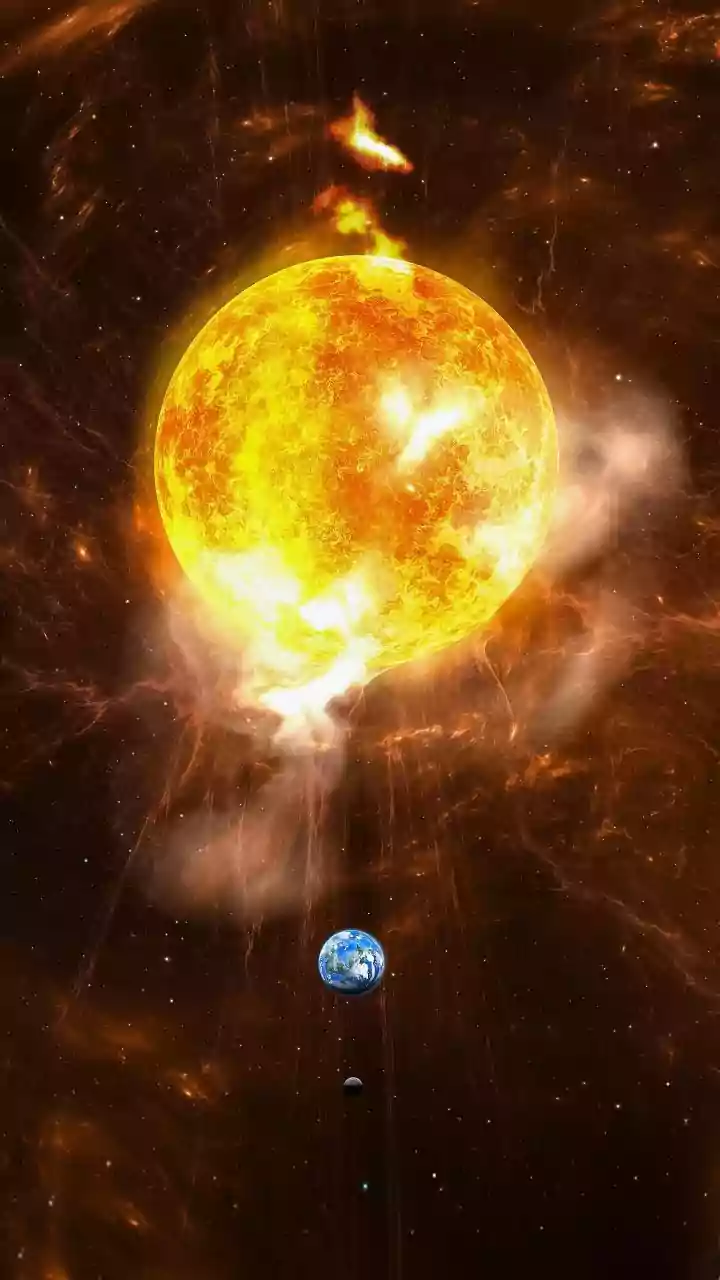
Here's a thought experiment that makes the concept crystal clear: what would happen if the Sun were to suddenly and magically vanish? For eight minutes and twenty seconds, everything on Earth would seem perfectly normal. The sky would be bright, the birds would sing, and we’d be completely unaware of the impending doom. We would continue to orbit a ghost, a gravitational memory of where the Sun used to be. Then, all at once, the light would switch off. The world would be plunged into an inky, star-lit blackness. But the chaos wouldn't stop there. Einstein’s theory of general relativity tells us that gravity also travels at the speed of light. So, at the exact same moment the light disappeared, the Earth would fly off its orbit and shoot into the cold, dark void of space in a straight line. It's a morbid scenario, but it’s a powerful illustration of how deeply connected the speed of light is to the very fabric of our reality, governing both what we see and how we move.