




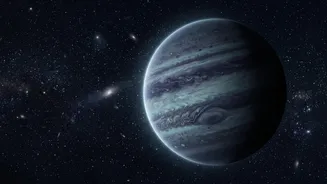

In the vast expanse of space, finding a new planet is a monumental achievement. So what happens when one of those newly discovered worlds simply vanishes? That's the mystery astronomers faced with TOI-2535 b, a planet that disappeared from view.
A Planet Hunter's Glimpse
To find
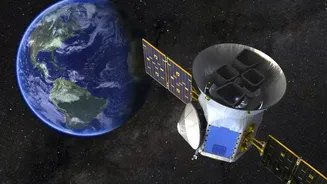
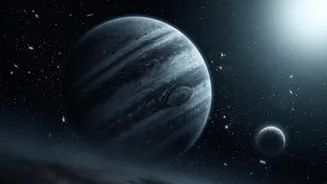
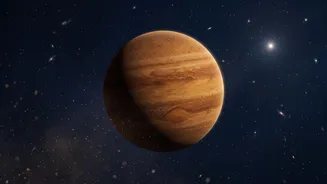
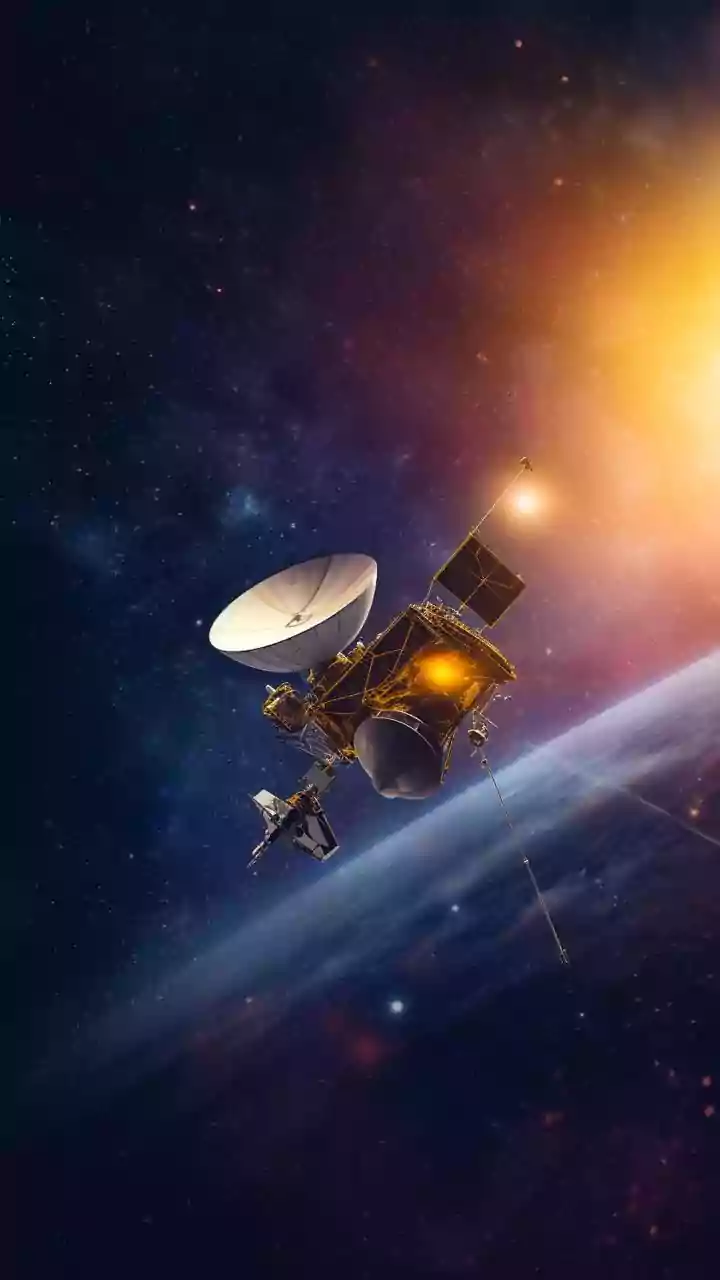
planets hundreds or thousands of light-years away, astronomers rely on clever techniques. One of the most successful is the 'transit method', used by NASA's Transiting Exoplanet Survey Satellite (TESS). TESS stares at stars, looking for tiny, periodic dips in their brightness. These dips are often the tell-tale sign of a planet passing in front of its star from our point of view, much like a tiny eclipse. Between April 2019 and March 2026, TESS observed a star system approximately 1,000 light-years away and detected just such a signal. The data pointed to a massive planet, dubbed TOI-2535 b, completing a scorching-hot orbit around its star in a mere 8.25 days. It was classified as a 'hot Jupiter'—a gas giant orbiting perilously close to its sun.
A Cosmic Disappearing Act
The discovery was exciting, but the planet's behaviour was odd. Over years of observation, astronomers noticed its transits were not like clockwork. The planet would sometimes cross its star up to six hours earlier or later than expected. Even more strangely, the transits themselves began to change, becoming shorter and shallower over time. Then, in early 2026, the signal vanished entirely. During its scheduled transit, TESS registered no dip in the star's light. The planet, which had been reliably observed for years, had seemingly disappeared into the cosmic void. It was the first time astronomers had directly observed a confirmed planet's transits cease in this manner around a single star.
Solving the Mystery
A planet doesn't just disappear. An international team of scientists, led by researchers at the University of California, Los Angeles (UCLA), dug into the puzzle. They didn't believe the planet had been destroyed or flung out of its system. Instead, the clues pointed to something far more subtle and fascinating: gravity. Their explanation, published in The Astrophysical Journal Letters, suggests that TOI-2535 b is not alone. The erratic timing of its transits and its eventual disappearance were caused by the gravitational pull of a second, unseen planet in the same system. This hidden companion is believed to be another giant planet, perhaps the mass of Saturn or greater.
A Celestial Wobble
The two massive planets are locked in a powerful gravitational dance. Their orbits are tilted relative to one another, causing them both to wobble like spinning tops, a phenomenon known as precession. According to Samuel Yee, a postdoctoral fellow at UCLA and corresponding author of the study, this is the most extreme example of such a strong planetary interaction ever witnessed. This intense wobble rapidly changed the tilt of TOI-2535 b's orbit. Over the seven years of observation, its path shifted from crossing the middle of the star to just grazing its edge, and finally, to missing the star's disk entirely from our line of sight. The planet is still there, dutifully orbiting its star, but its altered path means its transits are no longer visible from Earth.
Lessons from a Ghost Planet
The case of the 'disappearing planet' is more than just a solved mystery; it provides profound insights into how planetary systems form and evolve. Most hot Jupiters are thought to be lonely worlds, having been thrown into their tight orbits by chaotic events early in their history. The presence of a close, massive companion to TOI-2535 b suggests a different formation path. It likely migrated inward more slowly, spiraling in alongside its neighbor within the original disk of gas and dust that formed them. This discovery reminds astronomers that a system's visible planets may only be part of the story. For now, TOI-2535 b remains hidden. Scientists predict its wobbling orbit may bring it back into our view in 30 to 50 years.