
The Sun's Violent Outbursts
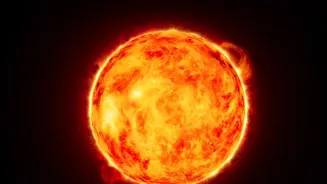
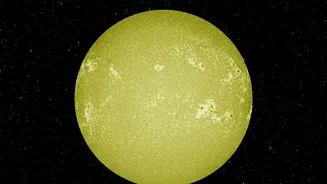
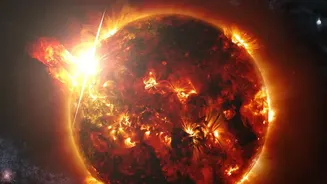
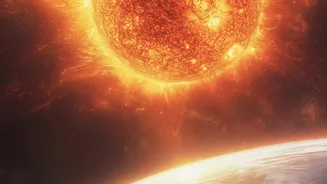
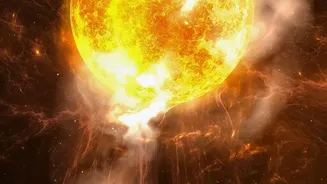
Our Sun is not always the calm, life-giving star it appears to be. It has a violent temper, periodically releasing enormous bursts of energy, plasma, and magnetic fields into space. These events, known as coronal mass ejections (CMEs) or solar flares,
send billions of tons of matter hurtling toward the planets. While Earth’s magnetic field protects us from most of this onslaught, a particularly powerful and well-aimed storm can have serious consequences for our technology-reliant civilisation. These are not hypothetical threats; they are a constant and natural part of living with a star.
A Shock to the System
When a powerful CME slams into Earth’s magnetic field, it can induce powerful electrical currents on the planet's surface. These are known as geomagnetically induced currents (GICs). These quasi-DC currents are a major hazard because they flow through any long conducting networks, such as power transmission lines, oil pipelines, and communication cables. For the power grid, GICs are especially dangerous. They can flow into high-voltage transformers, causing them to saturate, overheat, and even suffer permanent damage. This can lead to voltage fluctuations, equipment failure, and, in the worst-case scenario, a cascading collapse of the entire grid.
A Cautionary Tale from Quebec
The destructive potential of GICs was starkly demonstrated on March 13, 1989. A powerful solar storm struck Earth, and within seconds, the electrical grid in Quebec, Canada, collapsed. The geomagnetically induced currents overwhelmed the system's safeguards, tripping circuit breakers and leaving six million people without power for over nine hours in the cold. The event was a wake-up call, proving that space weather could cause widespread disruption and significant economic damage. It wasn't an isolated incident; the same storm caused over 200 power grid problems across the United States.
The Global Tripwire Network
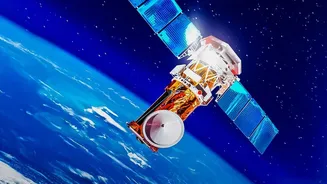
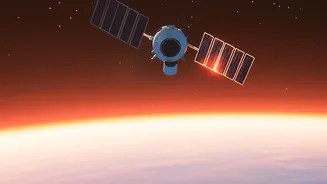
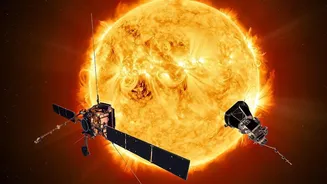
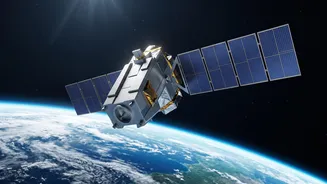
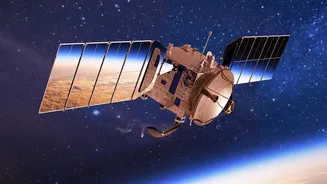
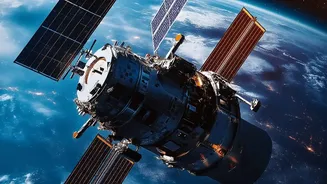
To prevent a repeat of the Quebec blackout, scientists and governments have established a sophisticated network of solar observatories. Satellites like the Deep Space Climate Observatory (DSCOVR) and the Solar and Heliospheric Observatory (SOHO) are positioned strategically between the Earth and Sun. These cosmic sentinels constantly monitor the Sun for CMEs. Because the charged particles from a CME travel slower than light, these satellites can provide an early warning. Agencies like the U.S. National Oceanic and Atmospheric Administration's (NOAA) Space Weather Prediction Center (SWPC) use this data to issue watches, warnings, and alerts with lead times ranging from minutes to days.
From Cosmic Alert to Earthly Action
When a space weather alert is issued, it's not a signal for public panic but a call to action for infrastructure operators. Power utility companies receive these notifications and can take preemptive measures to protect the grid. These actions might include reducing the load on certain transformers, postponing non-essential maintenance, rerouting power flows, or preparing to bring extra generation capacity online to stabilize the system. These operational adjustments help brace the grid against the incoming GICs, significantly reducing the risk of transformer damage and widespread blackouts. Studies have shown these forecasts can save economies billions by avoiding the worst impacts.
India's Eye on the Sun
India has significantly boosted its role in global space weather monitoring with the Aditya-L1 mission. Positioned at the L1 Lagrange point, about 1.5 million kilometers from Earth, Aditya-L1 has an uninterrupted view of the Sun. Its instruments study solar flares and CMEs, providing crucial data that enhances forecasting models. This allows for more accurate and timely warnings, not just for India but for the global community. By contributing to this worldwide effort, ISRO is helping to build a more robust shield against solar storms and secure our planet's critical infrastructure.