




Decoding a Planet's Atmosphere
To find out what a planet's atmosphere is made of from light-years away, scientists use a technique called transmission spectroscopy. It sounds complex, but the idea is quite simple. When an exoplanet passes in front of its host star from our perspective—an
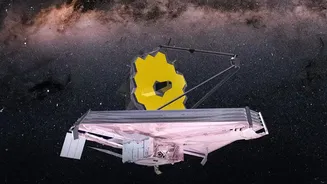
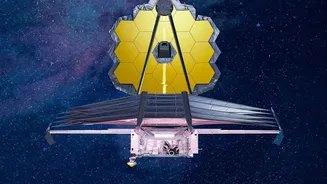
event called a 'transit'—a tiny fraction of the starlight filters through the planet's atmosphere. The James Webb Space Telescope is so sensitive it can capture this filtered light. Different molecules in the atmosphere absorb light at specific wavelengths, or colours. Each molecule, like water (H2O), has a unique chemical 'fingerprint'. By looking at which colours of light are missing from the starlight after it passes through the atmosphere, astronomers can identify exactly which molecules are present.
The Power of Infrared Vision
The JWST is particularly powerful for this task because it observes the universe in infrared light. Many key molecules, including water vapour, carbon dioxide, and methane, leave their prominent absorption signatures in the infrared part of the spectrum. Previous telescopes, like Hubble, have done similar work, but Webb’s larger mirror and advanced spectrographs provide unprecedented clarity and can detect these signatures with far greater detail. This allows scientists not only to detect the presence of water but also to begin to understand its abundance and the general conditions of the atmosphere, such as the presence of clouds or haze. It's the difference between knowing it rained and knowing exactly how many inches of rain fell.
Recent Breakthroughs and Discoveries
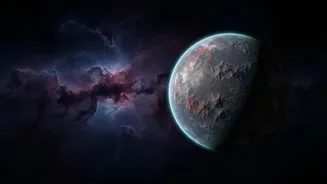
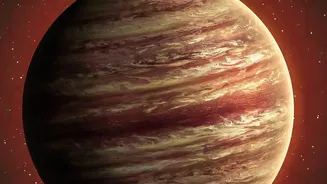
Recent findings from Webb have provided some of the clearest evidence of water vapour on exoplanets to date. One recent study highlighted a strong water vapour signal on WASP-94A b, a 'hot Jupiter' nearly 700 light-years away. Interestingly, the data showed that one side of the tidally locked planet was clear, revealing prominent water vapour absorption, while the other side was covered in mineral-based clouds. Other observations have detected hints of water vapour on rocky planets like GJ 486 b, though scientists are still cautious, working to confirm if the signal comes from the planet's atmosphere or its cool starspots. Even the detection of water in the planet-forming disk of the young star system PDS 70 suggests that the building blocks for watery worlds are available right from the start. Each detection expands our understanding of the different types of environments where water can persist.
More Than Just Finding Water
While finding water is a headline-grabbing achievement, the spectrum data reveals much more. These atmospheric readouts also show the presence of other gases like carbon dioxide. The combination and ratio of these molecules provide critical context. For instance, the presence of certain molecules together could hint at atmospheric processes and temperature conditions that might support life. Webb’s ability to analyse a wide spectrum of light at once gives a more holistic view of an exoplanet's atmospheric chemistry. This is crucial because habitability is about more than just one ingredient; it’s about the entire planetary system and its environment. Understanding the full atmospheric composition is a necessary step before we can make any judgments about a planet's potential to host life.