


A Cosmic Middle Ground
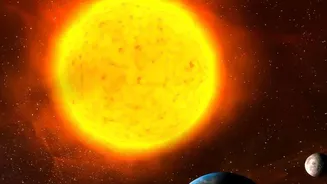
Imagine an object born like a star but without the destiny to shine. That's a brown dwarf. Often called 'failed stars', these objects form from the collapse of dense clouds of gas and dust, just like their stellar siblings. However, they never accumulate
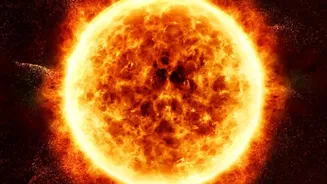
enough mass to kickstart the sustained nuclear fusion of hydrogen in their core, the very engine that makes stars like our Sun burn brightly for billions of years. The threshold for stardom is about 75 to 80 times the mass of Jupiter. Below this line, you get a brown dwarf. While they can't fuse hydrogen, the most massive brown dwarfs are hot enough in their youth to fuse a heavier version of hydrogen called deuterium, which allows them to glow faintly before they cool and dim over time like a dying ember.
The Planetary Behemoths
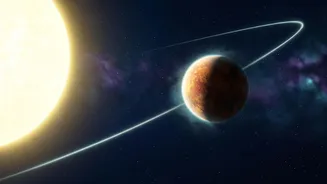
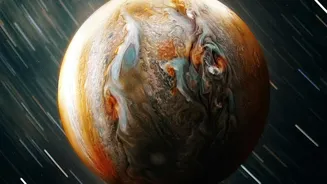
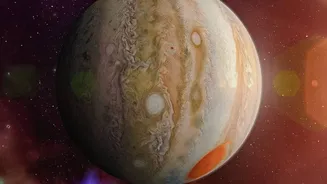
On the other side of this divide are the giant planets, familiar to us from our own solar system's Jupiter and Saturn. These are behemoths composed mostly of hydrogen and helium, swirling around a likely dense core. They don't generate their own light through fusion. Instead, any light we see from them is simply reflected from their parent star. The dominant theory for their formation, known as core accretion, suggests they are built from the bottom up. It starts with a rocky or icy core several times the mass of Earth, which then becomes gravitationally powerful enough to rapidly pull in vast amounts of gas from the dusty disk surrounding a young star. This process needs to happen quickly, within a few million years, before the star's stellar winds blow the gas away.
A Case of Mistaken Identity
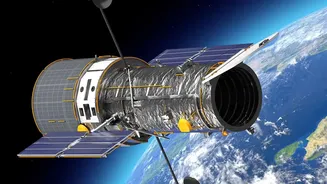
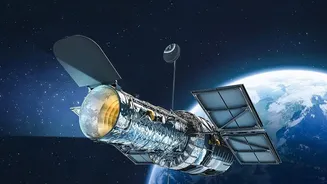
The confusion between brown dwarfs and giant planets arises because they can have strikingly similar physical traits. In terms of mass, the largest planets can be more massive than the smallest brown dwarfs. For a long time, the dividing line was thought to be around 13 times the mass of Jupiter, the minimum mass needed to fuse deuterium. However, recent discoveries from the James Webb Space Telescope (JWST) have found objects as small as two to four times Jupiter's mass that appear to have formed like stars, deeply blurring this distinction. Furthermore, their temperatures can overlap, and they can even be roughly the same size, as the intense gravity of a massive brown dwarf compresses it to a size similar to Jupiter's. Without knowing how and where an object was born, just looking at its mass or temperature isn't always enough to tell it apart.
The Telltale Origin Story
The true difference, astronomers now widely believe, lies in their birth. It’s a story of nature versus nurture. Brown dwarfs are born like stars: from the 'top-down' gravitational collapse of a large, turbulent cloud of interstellar gas. They are the primary product of this collapse, just a smaller version. Planets, on the other hand, are generally formed from the 'bottom-up' inside a protoplanetary disk of leftover material that encircles a newborn star. A brown dwarf is a lonely king of its own small castle, while a giant planet is a secondary creation, built from the scraps left over from its parent star's formation. This distinction is crucial, but it's not always easy to confirm. A brown dwarf could be ejected from its birth cluster and found wandering alone, looking much like a rogue planet that was kicked out of its own solar system.
Why This Cosmic Mystery Matters
Distinguishing between these objects is more than just astronomical bookkeeping. Understanding their origins helps scientists refine their models of how both stars and planets form. It addresses fundamental questions: What is the smallest possible star? And what is the largest possible planet? The answers have profound implications for our understanding of the universe's inventory, suggesting there could be billions of brown dwarfs in our galaxy alone. Studying the atmospheres of isolated brown dwarfs, which are easier to see without the blinding glare of a parent star, also provides a perfect laboratory for understanding the chemistry and weather on the gas giant exoplanets we hope to explore for signs of habitability in their moons. Ultimately, solving this identity crisis helps us piece together the complete story of how solar systems like our own come to be.