





Introducing the Habitable Worlds Observatory
NASA's next great flagship mission is the Habitable Worlds Observatory (HWO). Following in the footsteps of legendary instruments like the Hubble and James Webb Space Telescopes, HWO is being designed with an ambitious dual-purpose. Its primary goal is to become
the first telescope specifically engineered to search for signs of life on planets orbiting other stars. At the same time, it will offer powerful new capabilities for a broad range of astrophysical research, from studying how galaxies evolve to exploring objects in our own solar system. Recommended by the National Academies as the top-priority large space mission for the coming decade, HWO represents a major leap in our technological ability to answer one of humanity's oldest questions: Are we alone?
A 'Super Hubble' for a New Generation
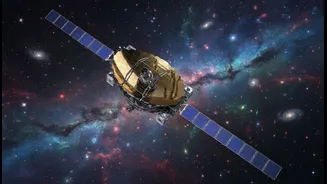
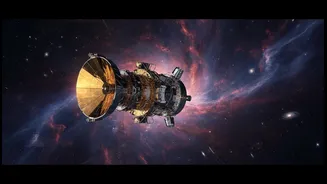
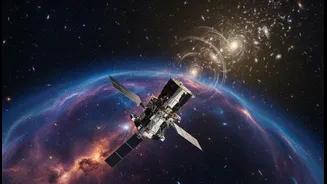
Often described as a 'Super Hubble,' the HWO will operate across ultraviolet, optical, and near-infrared wavelengths, similar to Hubble but with far greater power and precision. The current concept calls for a primary mirror around 6 to 8 meters in diameter, significantly larger than Hubble's 2.4-meter mirror, allowing it to gather more light and see fainter objects. Unlike the James Webb Space Telescope (JWST), which focuses on the infrared spectrum to see the early universe, HWO's multi-spectrum capability will provide a more comprehensive view of cosmic ecosystems. It will build on the legacies of both Webb and the upcoming Nancy Grace Roman Space Telescope, combining their lessons to create an observatory with unprecedented scope.
The Breadth: A Panoramic View of the Universe
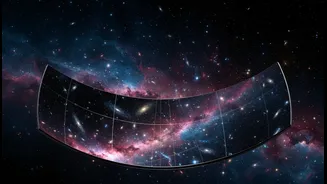
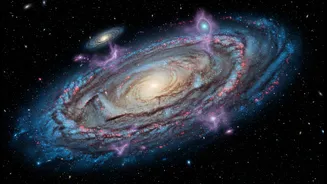
One half of HWO's mission is about breadth: conducting transformational astrophysics over wide areas. This involves tracing the very architecture of the cosmos, including the evolution of galaxies and the vast cosmic web of gas that feeds them. This capability is similar to the goals of the Roman Space Telescope, which is designed for wide-field surveys that capture massive statistical datasets. HWO will provide a similar panoramic capability, enabling scientists to study not just individual objects but the large-scale structures they form. This allows for a deeper understanding of how the universe is assembled and how galaxies, stars, and planets form and develop over cosmic time.
The Detail: Zeroing in on Habitable Worlds
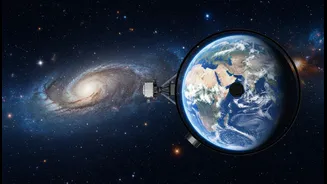
The other, more famous, part of HWO's mission is about detail: the direct imaging of Earth-like exoplanets. This is an immense technical challenge, as a planet is billions of times fainter than the star it orbits. To achieve this, HWO will be equipped with an advanced coronagraph, a sophisticated instrument that acts like a stellar shade, blocking the overwhelming glare of a star to reveal the faint pinpoint of light from a nearby planet. The goal is to directly image at least 25 potentially habitable worlds and then use spectroscopy to analyze their atmospheres. By breaking down the light from these planets, scientists can hunt for chemical biosignatures—gases like oxygen and methane—that could be evidence of life.
Building for the Future
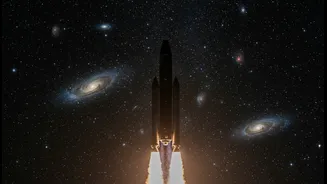
With a projected launch in the 2040s, the Habitable Worlds Observatory is a long-term project that requires developing new technologies. Engineers are working to create a coronagraph capable of starlight suppression ten billion times over, a massive improvement on current technology. The observatory itself will be a marvel of stability, with optics that must remain steady on the order of picometers—a fraction of the diameter of a single hydrogen atom. Taking lessons learned from the costly overruns of the James Webb telescope, NASA is focusing on maturing these critical technologies early. Furthermore, HWO is being designed from the ground up for robotic servicing, meaning its instruments could be upgraded and its lifespan extended for decades to come.