
Mathura's Signature: Dharwad Peda
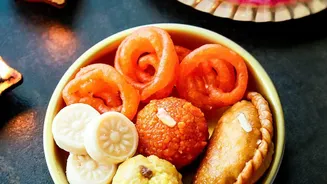
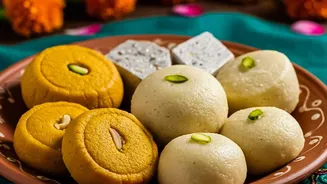
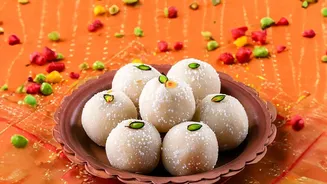
No Janmashtami celebration is complete without mentioning Mathura, Lord Krishna's birthplace. The city is famous for its pedas, a rich, caramelized milk sweet. Traditionally made by slow-roasting khoya (milk solids) until it turns a beautiful brown, these
pedas have a uniquely grainy texture and nutty flavour. Flavoured with cardamom and sometimes a hint of nutmeg, they are shaped by hand and often rolled in coarse sugar. Making them at home is a labour of love, but the result is a divine offering that connects you directly to the heart of the festival.
Maharashtra's Community Dish: Gopalkala
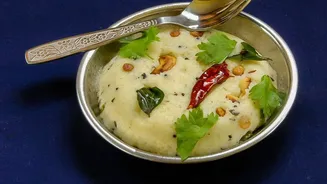
In Maharashtra, Janmashtami is synonymous with the boisterous Dahi Handi festival. The prasad that commemorates this is Gopalkala, a unique savoury dish. It's a no-cook recipe that symbolizes the meal Krishna shared with his cowherd friends, mixing whatever they had. The base is poha (flattened rice) mixed with curd, cucumber, pomegranate seeds, grated coconut, and sometimes puffed rice or soaked chana dal. It's all brought together with a flavourful tempering of ghee, cumin seeds, green chillies, and ginger. This refreshing and wholesome dish is a beautiful reminder of friendship and sharing.
North India's Fasting Essential: Dhaniya Panjiri
For those fasting on Janmashtami, grains are often avoided. This is where Dhaniya Panjiri, popular across Uttar Pradesh, Delhi, and Punjab, comes in. Instead of the usual whole wheat flour (atta), this panjiri uses roasted coriander seed powder as its base, making it grain-free. The coriander powder is roasted in ghee until fragrant and nutty, then mixed with powdered sugar, roasted makhana (fox nuts), and a generous assortment of chopped nuts and dried fruits like almonds, cashews, and raisins. It is a warming, aromatic, and deeply traditional prasad that keeps well for days.
South India's Crunchy Offerings: Seedai and Murukku
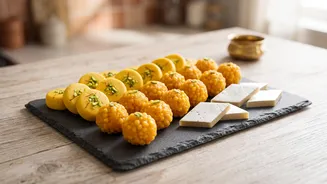
In South India, particularly Tamil Nadu, the festival known as Krishna Jayanthi or Gokulashtami is marked by the sound of crackling snacks. The most important offerings are Seedai—small, crunchy, deep-fried balls made from rice flour. They come in two main varieties: Uppu (salt) Seedai, which is savoury, and Vella (jaggery) Seedai, which is sweet. Alongside these, families prepare Murukku, a savoury spiral-shaped snack, and Thattai, a flat, crispy disc. These snacks are considered favourites of the playful child Krishna.
Bengal's Seasonal Delight: Taler Bora
In West Bengal, Janmashtami coincides with the season of the sugar palm fruit (Tal). This gives rise to a special delicacy called Taler Bora, or sweet palm fritters. The pulp of the ripe palm fruit is extracted and mixed with rice flour, semolina, grated coconut, and jaggery or sugar to form a thick batter. Small dollops of this fragrant batter are deep-fried until they turn a deep golden-brown, resulting in crispy exteriors and soft, fluffy insides. These fritters are a cherished and seasonal offering, deeply woven into the cultural fabric of the festival in the region.
Odisha's Temple Feasts: Rasabali
While Odisha is famous for the grand 'Chhapan Bhog' (56 food items) offered at temples like Puri Jagannath, one specific sweet stands out during Janmashtami celebrations: Rasabali. This delectable dessert consists of flattened patties of chhena (Indian cottage cheese) that are deep-fried until golden. These fried patties are then soaked in a thick, sweetened, and cardamom-flavoured milk (rabri). The result is a melt-in-the-mouth sweet that is both rich and comforting, representing the state's incredible tradition of milk-based desserts offered to the divine.