



A Surprising Discovery in the Cosmos
Astronomers using advanced tools like the James Webb and Hubble Space Telescopes have been diligently scanning the atmospheres of exoplanets—planets orbiting stars other than our Sun. A recent landmark observation detected significant water vapour in the atmosphere of a small
exoplanet named GJ 9827d, which lies 97 light-years away. While finding water is a landmark discovery in itself, the context of these findings is what's causing a stir in the scientific community. In some cases, the amount of water is far less than models predict, while in others, its mere presence in certain locations is baffling. These observations are forcing scientists to re-evaluate the fundamental theories of how planets, including the giants in our own solar system, come into being.
The Standard Recipe for Building Planets
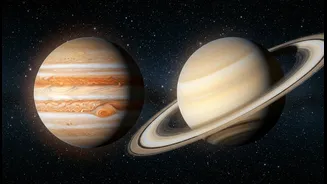
For decades, the leading theory of how large planets form has been 'core accretion'. Imagine a young star surrounded by a vast, rotating disc of gas and dust. In this disc, tiny dust particles begin to stick together, like dust bunnies under a bed. Through countless collisions, they grow from pebbles to boulders, and eventually into massive rocky cores, ten to twenty times the mass of Earth. Once a core becomes massive enough, its powerful gravity begins to pull in huge amounts of surrounding gas, forming the thick, hydrogen-rich atmospheres we see on giants like Jupiter and Saturn. A key part of this model is the 'snow line'—an orbit far enough from the star where temperatures are cold enough for water to freeze into ice. This ice is considered a crucial ingredient, helping planetary cores grow large enough, fast enough, to grab their gassy envelopes before the star's solar wind blows the disc material away.
New Data Creates a Cosmic Conundrum
The latest exoplanet observations are throwing a spanner in the works of this tidy theory. Some discoveries show planets with water-rich atmospheres that must have formed far out past the snow line and then migrated inwards. However, other extensive surveys have found that many gas giants have surprisingly low amounts of water in their atmospheres, suggesting they didn't form with substantial ice accretion at all. The detection of water vapour in the hot, inner region of a planet-forming disc called PDS 70 was particularly surprising to astronomers. According to the core accretion model, this region should be too hot and harsh for water to survive. These inconsistencies suggest that our 'standard recipe' is missing some key steps, or that nature has more than one way to cook up a planet.
Rewriting the Cosmic Playbook
These puzzling findings have reinvigorated the debate around alternative planet-formation theories. One contender is 'disk instability'. This 'top-down' model suggests that instead of building up from small pieces, giant planets can form rapidly when a massive, unstable protoplanetary disk cools and breaks apart into planet-sized clumps of gas and dust. This process could explain the formation of planets far from their stars, where the core accretion method would be too slow. Scientists are now exploring hybrid models that might combine elements of both theories or investigating more complex processes like 'pebble accretion,' where cores grow by sweeping up swarms of smaller, pebble-sized objects. Each new atmospheric reading from an exoplanet provides another clue, helping astronomers refine these models to better match the diverse and surprising variety of worlds observed across our galaxy.