





The Sun's Hidden Temper
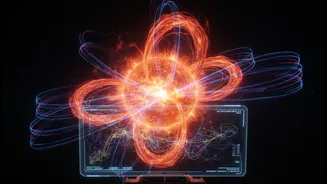
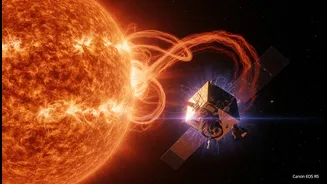
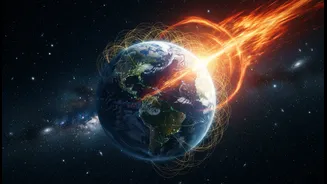
The sun, our life-giving star, has a volatile side. It periodically releases massive bursts of energy and particles in events known as solar flares and coronal mass ejections (CMEs). These are the primary drivers of what scientists call "space weather".
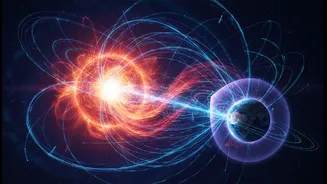
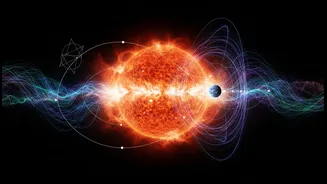
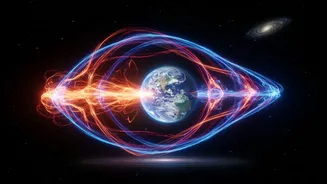
When a CME is aimed at Earth, it sends a supercharged cloud of plasma hurtling through space. If it hits our planet's magnetic field, it can trigger a geomagnetic storm, an event with the power to disrupt our technologically-dependent lives in profound ways. While Earth's atmosphere protects us on the ground from the harmful radiation, the infrastructure we have placed in orbit is far more exposed.
Satellites in the Firing Line
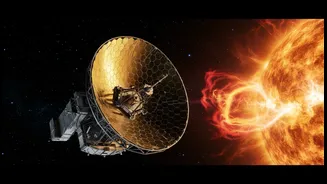
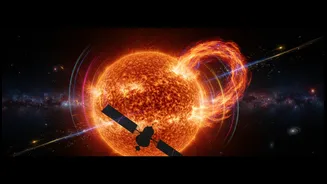
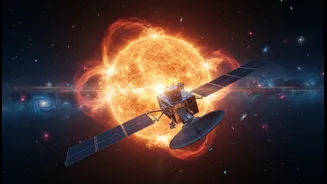
Our orbital infrastructure is a critical, yet fragile, part of the global economy. Satellites for GPS, communication, weather forecasting, and financial transactions are all vulnerable to space weather. A powerful solar storm can affect them in several ways. The influx of high-energy particles can damage sensitive electronics and solar panels, sometimes causing phantom commands or complete system failure. Storms also heat and expand Earth's upper atmosphere, increasing drag on satellites in low-Earth orbit. This can cause their orbits to decay, forcing them to burn precious fuel to stay on course or risk falling out of the sky. In 2022, a minor solar storm was enough to cause the failure of 40 newly launched satellites.
The Domino Effect on Earth
The impact isn't confined to space. Disrupted satellite signals can lead to GPS navigation errors, affecting aviation, shipping, and logistics. High-frequency radio blackouts can sever communications, particularly for flights over polar routes. Perhaps most seriously, severe geomagnetic storms can induce powerful currents in national power grids, potentially overloading transformers and causing widespread, long-lasting blackouts. As our world becomes ever more connected and reliant on space-based technology, our vulnerability to the sun's whims only increases, making the ability to predict these events a critical necessity.
The Rise of the Space Weather Forecaster
Just as meteorologists forecast weather on Earth, a specialised field of scientists works to predict storms in space. These space weather forecasters analyse data from solar observatories to monitor the sun for threatening activity like sunspots, flares, and CMEs. By modelling the path and intensity of a solar eruption, they can issue watches and warnings, giving satellite operators, power grid managers, and airlines crucial time to take protective measures. This can involve putting satellites into a protective safe mode, rerouting flights, or preparing utility networks for potential surges. It is a high-stakes role that operates at the intersection of astrophysics, data science, and public safety.
A Career Written in the Stars
The growing reliance on space infrastructure has turned space weather forecasting into a viable and expanding career path. In India, agencies like the Indian Space Research Organisation (ISRO) are at the forefront, with missions like Aditya-L1 dedicated to studying the sun and improving space weather prediction. Scientists at the Indian Institute of Geomagnetism and Indian Institute of Astrophysics are also developing new models to better forecast solar events. A career in this field typically requires a strong background in physics, atmospheric science, astronomy, or a related discipline, often with a postgraduate degree. Key skills include data analysis, computational modeling, and physics-based research. Professionals are employed by national space agencies, research institutions, and increasingly, by private companies in the aerospace, aviation, and communications sectors.