





The Orbiter's Silent Victory
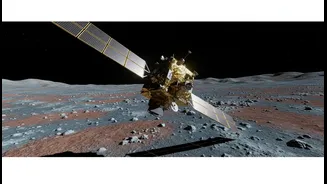
While the world watched the dramatic landing attempt of the Vikram lander in 2019, the other half of the Chandrayaan-2 mission, its orbiter, was just beginning its work. Silently circling the Moon from a 100 km polar orbit, this sophisticated spacecraft
has been a quiet champion, packed with scientific instruments that are fundamentally changing our understanding of our celestial neighbour. Though the landing was unsuccessful, the orbiter has been an overwhelming success, continuously sending back high-quality data that forms the bedrock of future lunar ambitions, both for India and the world. It has outlived its initial planned mission life, providing a treasure trove of information that is proving to be more valuable with each passing year.
The Search for Buried Treasure: Water Ice
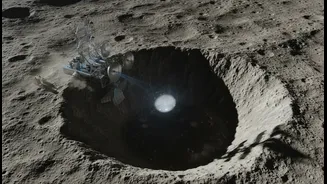
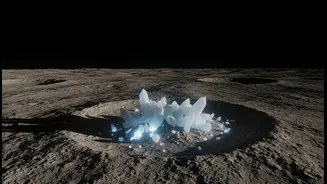
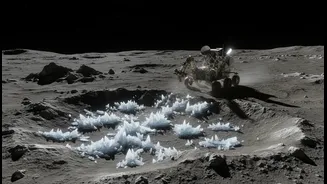
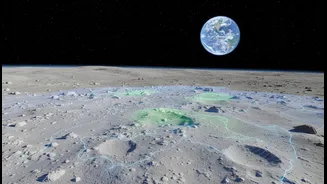
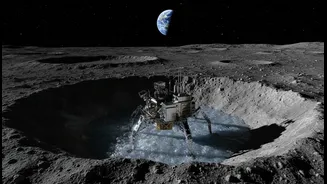
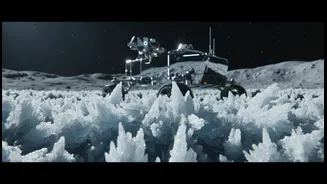
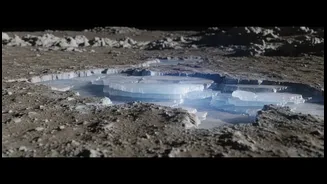
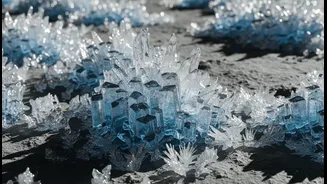
The single most critical resource for establishing a human presence on the Moon is water. It can be used for drinking, growing food, creating breathable oxygen, and, crucially, being split into hydrogen and oxygen to make rocket fuel. This is where Chandrayaan-2's most significant contributions lie. Its Dual-frequency Synthetic Aperture Radar (DFSAR) is a game-changing instrument. Unlike cameras that only see the surface, DFSAR can probe several metres below the lunar soil, especially in the permanently shadowed craters of the south pole where sunlight never reaches. Recent findings from scientists at the Physical Research Laboratory, using DFSAR data, have provided strong evidence of significant deposits of subsurface water ice in these frigid, dark craters. It's estimated that the amount of ice buried in the first few metres could be five to eight times larger than what's on the surface. This isn't just a discovery; it's a map pointing to where future missions should go to extract this vital resource.
More Than Just Water: A Blueprint for Building
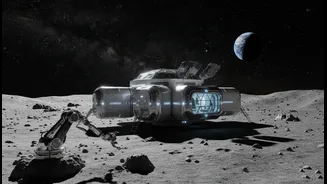
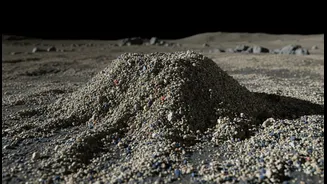
While water is key, building a sustainable presence requires more. We need to know what the Moon is made of. The Chandrayaan-2 orbiter is equipped with other powerful tools for this purpose. The Imaging Infra-Red Spectrometer (IIRS) maps the lunar surface for minerals, providing high-resolution data on the composition of the regolith, or lunar soil. Another instrument, the Large Area Soft X-ray Spectrometer (CLASS), determines the elemental composition, and has already successfully mapped the abundance of sodium across the Moon. This detailed mineralogical and elemental mapping is essential for In-Situ Resource Utilisation (ISRU) — the concept of living off the land. By understanding the soil's composition, future missions can plan for using local materials for construction, perhaps creating a form of lunar concrete, and even extracting other valuable elements, drastically reducing the cost and complexity of missions by not having to haul everything from Earth.
Powering the Next Generation of Lunar Missions
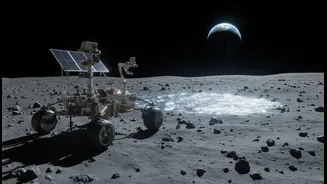
The data from Chandrayaan-2 isn't just for academic papers; it is directly informing the next wave of global space exploration. NASA's Artemis Program, which aims to return humans to the Moon and establish a permanent base, relies on this kind of resource mapping to choose landing sites and plan its long-term strategy. India's role as a signatory to the Artemis Accords means that its data, particularly the unique insights from the DFSAR and IIRS instruments, is a vital contribution to this international effort. More importantly, this information is critical for ISRO's own ambitious future. With plans for a Chandrayaan-4 sample return mission, a human landing by 2040, and even a space station, knowing exactly where to find and access lunar resources is the first and most important step. Chandrayaan-2 has effectively provided the initial blueprint for this exciting future.