





Gaganyaan: India's Leap into Human Spaceflight
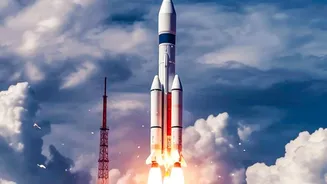
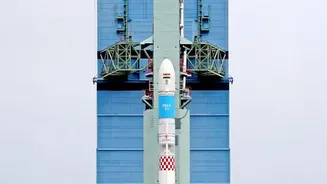
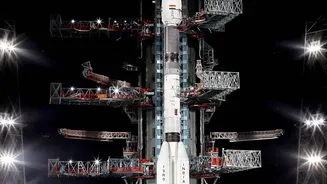
The most anticipated mission on ISRO's roster is Gaganyaan, India's first human spaceflight program. The goal is to send a crew of three astronauts into a 400-kilometre orbit for a three-day mission and bring them back safely. Achieving this will make
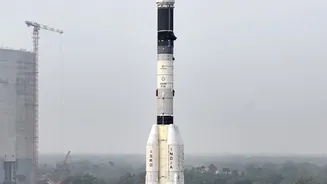
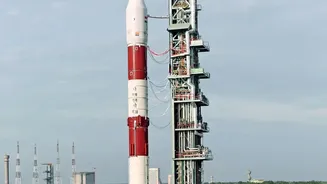
India the fourth country in the world, after Russia, the USA, and China, to have an independent human spaceflight capability. The journey is methodical and safety-focused, with a series of uncrewed test flights. The G1 uncrewed mission is slated for the latter half of 2026, which will test the crew module, life support, and recovery operations. This will be followed by another test flight carrying Vyommitra, a humanoid robot, to validate systems before the first crewed launch. The entire program uses a human-rated LVM3 rocket, a modified version of ISRO's reliable heavy-lift launch vehicle.
Return to the Moon: A Bolder Lunar Quest
Building on the historic success of Chandrayaan-3's south pole landing, ISRO is planning an even more complex lunar mission: Chandrayaan-4. Scheduled for launch around 2028, this mission aims to achieve what only a handful of nations have done: perform a lunar sample return. The spacecraft will land on the Moon, collect surface and sub-surface samples with a robotic arm and drill, and then launch a module back to Earth with the precious cargo. This incredibly complex mission involves multiple modules and two separate launches. Success would provide Indian scientists with pristine lunar material for study, offering insights into the Moon's origin and evolution. The technologies demonstrated, such as ascending from the lunar surface and in-orbit docking, are crucial steps towards future human landings on the Moon.
To the Inner Planets: Venus and Mars
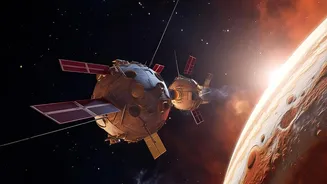
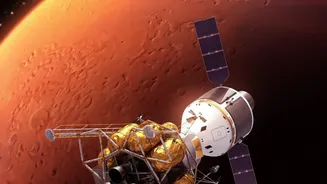
ISRO is also expanding its interplanetary reach with ambitious missions to our planetary neighbours. First is Shukrayaan-1, India's inaugural mission to Venus, planned for a 2028 launch. Venus, often called Earth's 'evil twin' due to its runaway greenhouse effect and hostile surface, holds key secrets about planetary evolution. Shukrayaan will study its thick, toxic atmosphere, volcanic activity, and mysterious super-rotating clouds to understand why it evolved so differently from Earth. Following the groundbreaking Mangalyaan orbiter, Mangalyaan-2 will mark India's first attempt to land on Mars. This mission, tentatively scheduled for the 2028-2030 timeframe, is a significant technological jump, aiming to deploy a lander, a rover, and even a helicopter. This would place India in the elite club of nations that have successfully operated rovers on the Martian surface, gathering ground-level data on its geology and atmosphere.
A Home in the Heavens: The Bharatiya Antariksha Station
Perhaps the most visionary of ISRO's future plans is the establishment of the Bharatiya Antariksha Station (BAS), India's own modular space station. Envisioned as a long-term platform for scientific research in low Earth orbit, the station will allow Indian astronauts to live and work in space for extended periods. The first module of the five-module station is targeted for launch in 2028, with the full station expected to be operational by 2035. The BAS will serve as a hub for microgravity experiments, technology development, and will be a critical stepping stone for even more ambitious goals, such as sending an Indian astronaut to the Moon by 2040.