








Meet the 'Pink Planet'
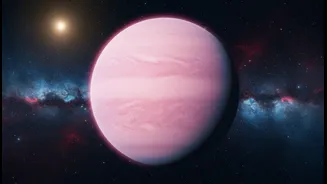
First spotted in 2013 by the Subaru Telescope in Hawaii, GJ 504 b is a massive object orbiting a sun-like star in the constellation Virgo. What immediately captured the public's and scientists' imagination was its distinct color. This dull magenta hue
isn't from any surface feature but is the faint glow of residual heat left over from its violent formation. While its temperature of around 290 degrees Celsius is hotter than a kitchen oven, it's remarkably cool for a young, giant celestial body, allowing this unique color to shine through in infrared observations. Early analysis suggested it was about four times the mass of Jupiter, making it the lowest-mass exoplanet to be directly imaged at the time. However, this distant world was just getting started with its surprises.
A Planet That Shouldn't Exist?
Here is where the 'explainer value' of GJ 504 b truly shines. The leading theory for how giant planets form is called 'core accretion'. In this model, small particles of rock and ice in the disk around a young star collide and stick together, gradually building a 'core'. Once this core becomes massive enough, its gravity pulls in huge amounts of gas from the disk, creating a giant like Jupiter. This model works well for planets in orbits like our own gas giants. However, GJ 504 b orbits its star at a vast distance, at least nine times farther than Jupiter is from our sun. At that distance, the material in the protoplanetary disk would have been too sparse for a core to grow large enough, fast enough, to become a gas giant. Its existence poses a direct challenge to this textbook model.
An Alternate Theory... With a Catch
If core accretion is unlikely, what's the alternative? Scientists have another model called 'gravitational instability'. This theory proposes that in a very massive and unstable protoplanetary disk, portions of the disk can collapse directly under their own gravity, rapidly forming a giant planet in a few thousand years instead of millions. This process is thought to work better at large distances from a star, making it a tempting explanation for GJ 504 b. The problem is, the specific properties of GJ 504 b's star system and the planet itself don't neatly fit the conditions required for this model either. It seems this pink planet is determined to be an outlier, a celestial object that forces scientists back to the drawing board to refine or even rethink their theories.
New Clues from the Webb Telescope
For years, the planet remained an enigma, too faint for detailed study by ground-based telescopes. But the powerful James Webb Space Telescope (JWST) has recently provided a stunning new look. In observations from mid-2026, astronomers found that GJ 504 b is likely much older and more massive than first thought—perhaps up to 25 times the mass of Jupiter. This places it on the blurry line between a giant planet and a 'brown dwarf,' an object more massive than a planet but not massive enough to ignite into a star. Most surprisingly, the Webb telescope detected the chemical signatures of salty clouds in its atmosphere, the first time such clouds have been directly observed and confirming a long-held hypothesis about cold, distant worlds.