



The Cosmic Connection Problem
Since the dawn of the space age, missions have relied on radio frequency (RF) waves to send and receive data. This trusted method has brought us iconic views from Mars rovers and distant probes. However, RF communication faces a major bottleneck: bandwidth.
As scientific instruments become more advanced, capturing high-definition video and vast amounts of data, radio waves struggle to keep up. Transmitting a complete, high-resolution map of Mars using current RF technology could take as long as nine weeks. It’s like trying to stream a 4K movie on an old dial-up internet connection; the pipeline simply isn’t big enough for the amount of data we now want to send.
A Leap to Laser-Fast Speeds
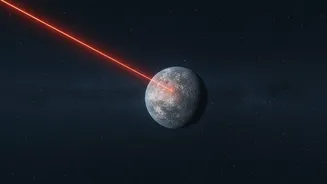
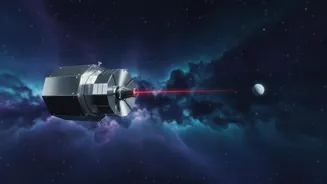
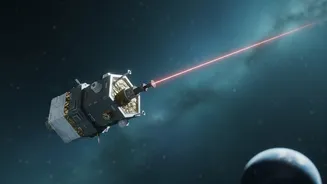
The solution is to move up the electromagnetic spectrum from radio waves to light. Specifically, near-infrared lasers. This technology, known as optical or laser communication, works on a simple principle: higher frequency waves can carry more information. While both radio and infrared signals travel through space at the same speed—the speed of light—infrared light waves are packed much more tightly together. This tighter wavelength allows engineers to encode significantly more data into each transmission. The result is a massive increase in data rates, potentially 10 to 100 times faster than the most advanced RF systems used today.
Proof of Concept: The DSOC Mission
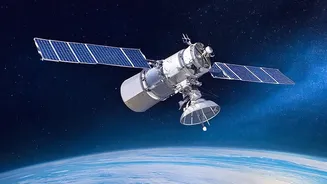
This isn't just theory; NASA has already proven it works. The Deep Space Optical Communications (DSOC) experiment, which launched aboard the Psyche spacecraft in October 2023, was designed to test this very technology. In December 2023, the system made history by streaming a high-definition video of a cat named Taters from 19 million miles away. It transmitted the video at a blistering 267 megabits per second (Mbps)—a rate comparable to many home broadband connections. As the spacecraft traveled farther, DSOC continued to set records, successfully sending data from over 140 million miles away. These tests demonstrated that optical communication is not just viable but vastly superior for high-volume data transfer across interplanetary distances.
Not Without Its Challenges
Despite its advantages, laser communication isn't a simple plug-and-play upgrade. Its greatest strength—the narrowness of the laser beam—is also a significant challenge. Unlike radio waves, which spread out widely, a laser beam must be aimed with incredible precision. Over a distance of millions of miles, being off by even a fraction of a degree means the beam will miss its target receiver on Earth entirely. Ground-based receivers also face interference from Earth's atmosphere. Clouds can block the signal, requiring strategically placed receiving stations in areas with clear weather patterns. Furthermore, the sun itself generates infrared radiation, which can create background noise and interfere with transmissions.
The Future of Interplanetary Internet
The success of DSOC marks the beginning of a new chapter in space exploration. The ability to quickly transmit massive datasets will allow future missions to carry more powerful scientific instruments, accelerating the pace of discovery. For human exploration, the implications are even more profound. Future astronauts on Mars could stream live, high-definition video back to Earth and communicate with mission control in near real-time, greatly enhancing both safety and public engagement. Beyond speed, optical communication systems are also smaller, lighter, and require less power than their radio counterparts, freeing up valuable mass and energy for other critical spacecraft systems. This efficiency is crucial when designing complex, long-duration missions to other worlds.