


Cosmic Beacons of Destruction
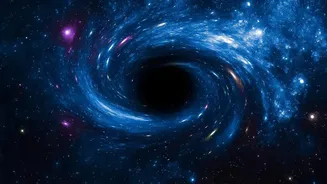
Imagine an explosion so powerful it outshines a billion trillion suns. This is a gamma-ray burst (GRB), the universe's most violent and energetic phenomenon. These are not simple explosions; they are the birth cries of black holes or the cataclysmic mergers
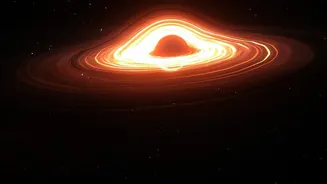
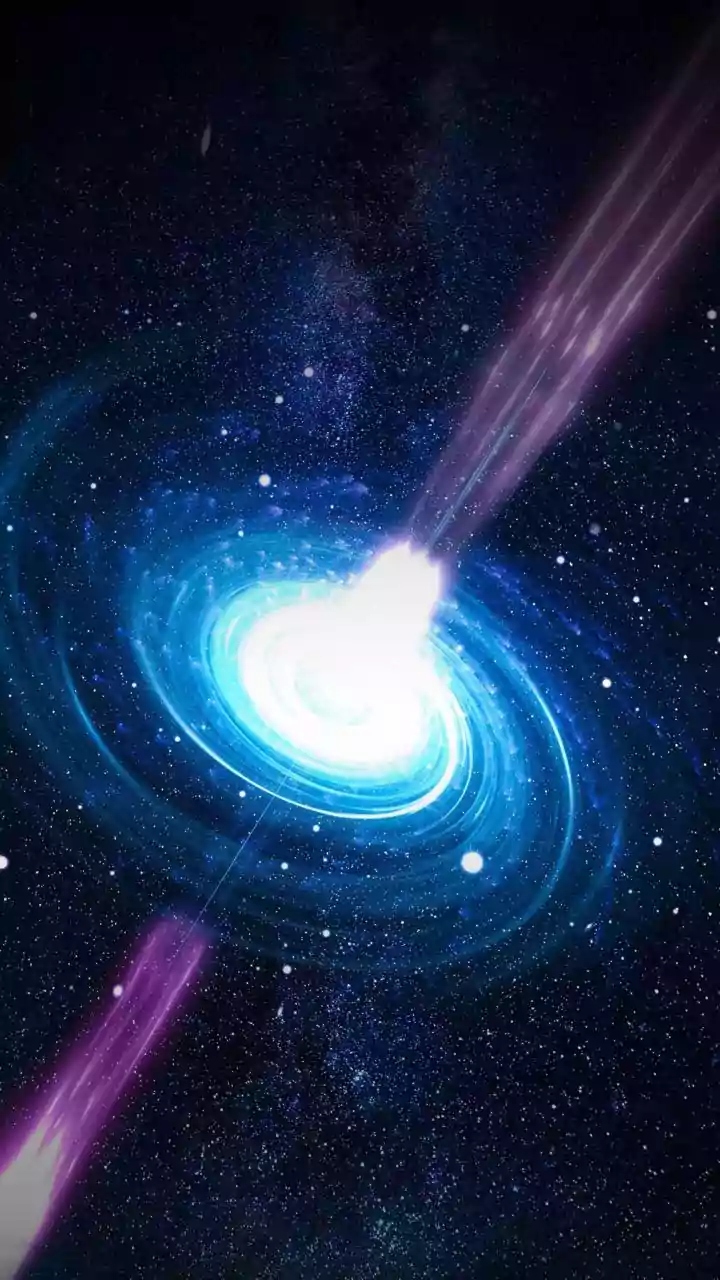
of dead stars. For a few fleeting seconds, or sometimes minutes, they unleash more energy than our sun will in its entire 10-billion-year lifetime. Astronomers have long classified them into two main types: short bursts, caused by the collision of dense neutron stars, and long bursts, resulting from the core-collapse of a massive star into a black hole. In either case, the result is a newborn black hole surrounded by a swirling disc of superheated matter. This chaotic environment acts as the 'central engine', launching twin jets of plasma at nearly the speed of light. As these jets tear through space, they produce the brilliant flash of gamma rays we detect billions of light-years away.
A Ten-Year Cosmic Watch
While the initial burst is over in moments, the story of a GRB is far from finished. The jets continue to barrel outwards, slamming into surrounding gas and dust to create a slowly fading 'afterglow' that can be observed for days, months, or even years across the electromagnetic spectrum, from X-rays to visible light and radio waves. By systematically studying these afterglows over the past decade or more, using an array of ground and space-based telescopes, scientists have effectively conducted a long-form survey of these distant cataclysms. This sustained observation has revealed that the afterglow is not just a simple, smooth fade. Instead, it often displays complex behaviour, with unexpected plateaus, flares, and breaks in its light curve—the plot of its brightness over time. These variations, once seen as mere curiosities, are now understood to be vital clues.
The Evolving Light Signature
The key insight from these long-term observations is that the GRB's light 'evolves'. Rather than just dimming, the characteristics of the afterglow change. For instance, astronomers have noted that the decay rate of the light isn't always constant. Recent studies have focused on analysing the specific shape of the light curve's decay. The slope of this decay can be measured and compared against theoretical models of what happens inside the central engine. Scientists have found that different processes inside the engine should produce different decay slopes in the light curve we observe millions or billions of years later. These evolving signatures are like a coded message, telling a story about the chaos unfolding at the heart of the explosion long after the initial burst has faded.
Peering Inside the Central Engine
This evolving light directly links to the activity of the central black hole. The 'engine' of a GRB isn't a simple on/off switch. After its formation, the black hole continues to feed voraciously on the surrounding material from the collapsed star or merger debris. This process is called hyperaccretion. How the black hole accretes this matter, and how its powerful magnetic fields behave, determines the properties of the jet and, consequently, the afterglow. For example, a plateau or a sudden re-brightening in the X-ray afterglow suggests that the central engine has sputtered back to life, injecting a fresh burst of energy into the outward-moving shockwave. Some recent, extremely long-lasting GRBs have shown engine activity for weeks, proving that these black holes can remain active far longer than previously thought. By studying the decay slopes and flare patterns, researchers can now begin to distinguish between different engine mechanisms, such as whether the jets are powered by extracting the black hole's spin energy (the Blandford-Znajek process) or by energy from neutrino annihilation.
A New Window into Black Holes
The ability to connect the evolving light of a GRB to the physics of its central engine is a major leap forward for astrophysics. It means astronomers are no longer just observing the aftermath of an explosion; they are using the light from that aftermath to probe the fundamental processes governing the birth and feeding habits of stellar-mass black holes. For a long time, the inner workings of GRB jets were a 'black box'. Now, detailed observations over the past decade have given us the tools to look inside that box. The brightness, duration, and evolution of a GRB's afterglow act as a diagnostic tool, revealing the secrets of the most extreme environments in the cosmos. These findings challenge existing models and force theorists to build a more complete picture of how dying stars create these spectacular, universe-altering events.