


A Mission of Two Halves
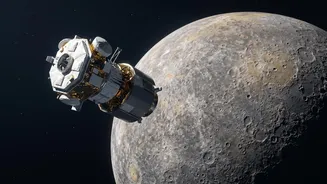
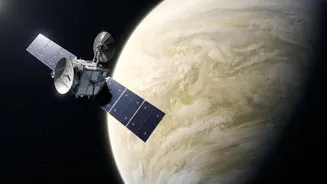
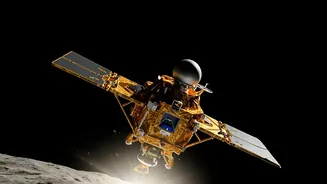
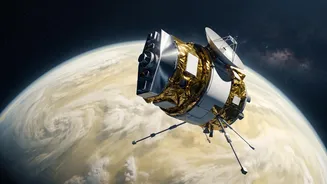
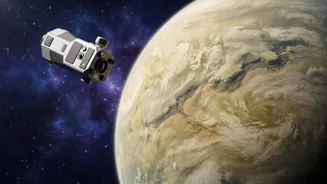
BepiColombo is not just one spacecraft, but a trio of modules that have journeyed together since launching in October 2018. It's a joint project between the European Space Agency (ESA) and the Japan Aerospace Exploration Agency (JAXA). The mission consists
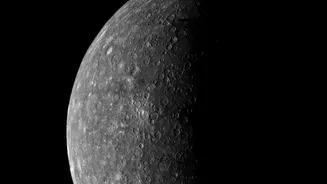
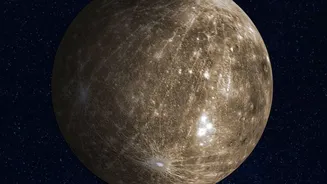
of the Mercury Transfer Module (MTM), which has provided propulsion for the long trip, and two scientific orbiters stacked on top: ESA’s Mercury Planetary Orbiter (MPO) and JAXA’s Mercury Magnetospheric Orbiter, nicknamed Mio. This collaborative approach allows for a comprehensive study of Mercury, with MPO set to map the planet's surface and interior, while Mio focuses on its mysterious magnetic field and magnetosphere. Only two spacecraft have visited Mercury before, making BepiColombo a crucial mission to understand the least explored rocky planet in our solar system.
The Long and Winding Road
Getting into orbit around Mercury is incredibly difficult. The Sun's immense gravity constantly accelerates any spacecraft heading inward, meaning BepiColombo has had to continuously brake to avoid overshooting its target. The mission has followed a long and complex trajectory spanning billions of kilometres. This journey involved one gravity-assist flyby of Earth, two of Venus, and six of Mercury itself. These flybys were essential for shedding velocity and carefully shaping the spacecraft's path. The journey was extended by almost a year, to November 2026, after a power-related issue with the craft's solar electric propulsion system required engineers to plot a new, lower-thrust trajectory.
The Arrival Sequence
The mission's arrival phase is a meticulously planned series of events. It officially began on September 3, 2026, with the successful separation of the Mercury Transfer Module, which has now completed its job. The two science orbiters, still stacked together, will now navigate the final leg of their journey. The next critical moment comes on November 21, 2026, when the spacecraft will be weakly captured by Mercury's gravity, officially entering orbit. However, this is just the beginning of a process that will take several months. A sequence of 16 manoeuvres will progressively lower and refine the orbit. The two orbiters will then separate in December, with Mio moving into its final highly elliptical orbit, followed by MPO settling into its own path by March 2027.
Unlocking the Planet's Secrets
Once science operations begin in April 2027, BepiColombo will start tackling some of Mercury's biggest puzzles. Scientists are eager to understand why the planet is so dense, what generates its Earth-like magnetic field, and the origin of the mysterious water ice deposits found in permanently shadowed craters at its poles. The MPO will map the surface and analyse its composition to understand Mercury's geological history. Simultaneously, Mio will study the interaction between the planet's magnetic field and the powerful solar wind. By having two spacecraft operating at once, scientists will gain a unique, three-dimensional view of Mercury and its environment, promising to revolutionize our understanding of how planets form and evolve so close to their star.