


The Solar System's Reigning Moon King
The headline's claim of 293 moons is not just accurate—it’s a recent development. As of June 2026, Saturn officially holds the title for the most moons in the solar system. This number has surged dramatically, with astronomers confirming 128 new moons in March
2025 and another batch in 2026, solidifying its lead over Jupiter. These discoveries reveal that Saturn's gravitational reach has captured a vast swarm of objects. The majority of these are small, irregular bodies, some just a few kilometres wide, likely captured asteroids or fragments from ancient collisions. However, this diverse family also includes giants like Titan, which is larger than the planet Mercury and boasts a thick nitrogen atmosphere with liquid methane lakes. Then there's Enceladus, a smaller icy moon with a global subsurface ocean that erupts into space, feeding one of Saturn's rings. This incredible variety, from tiny rock fragments to worlds with complex geology, makes Saturn's moon system a miniature solar system in itself.
A Planet Lighter Than Water
One of Saturn’s most famous and counterintuitive traits is its low density. On average, the entire planet is less dense than water. If you could find a bathtub colossal enough to hold it, Saturn would float. This isn't because the planet is empty, but because it's made of incredibly light materials. Saturn is a gas giant composed almost entirely of hydrogen and helium, the two lightest elements in the universe. While it has a dense, rocky core deep within, this core is enveloped by vast layers of compressed gases and liquid hydrogen. Because its immense volume is filled with such lightweight substances, its overall average density remains surprisingly low. This composition explains why Saturn is the second-largest planet by size but only has about a third of Jupiter's mass; it's a giant, but a remarkably airy one.
The Unrivaled Majesty of the Rings
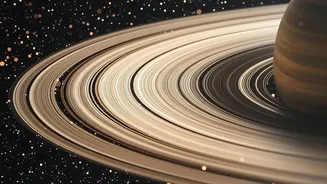
While other planets like Jupiter and Uranus have faint rings, Saturn’s are spectacular and complex. They are not solid but are made of billions of individual particles of water ice, rock, and dust, ranging in size from tiny grains to chunks as large as a house. These particles are highly reflective, which is why the rings are so bright and visible from Earth. The main ring system stretches across hundreds of thousands of kilometres but is astonishingly thin, in most places no more than 100 meters thick. Scientists believe the rings are relatively young, possibly formed from the debris of a shattered moon, comet, or asteroid torn apart by the planet's powerful gravity. The intricate structure of gaps and divisions, like the famous Cassini Division, is maintained by the gravitational pull of Saturn’s many moons.
A Storm Shaped Like a Hexagon
At Saturn's north pole spins one of the most bizarre weather patterns ever observed: a six-sided jet stream known as the hexagon. This colossal storm is about 30,000 kilometres wide, meaning its sides are longer than the diameter of Earth. It's not a solid structure but a powerful current of air, with winds whipping around at over 300 kilometres per hour. First spotted by the Voyager spacecraft in the 1980s, its stability has fascinated scientists for decades. Theories suggest it's a type of planetary wave, a meander in the jet stream that has settled into a stable six-sided pattern due to the planet's rotation and atmospheric conditions. Inside this strange shape, other vortices and storms rage, making Saturn's pole a hub of unique and violent weather unlike anything seen elsewhere.