
Why We're Going to Venus
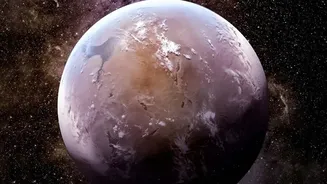
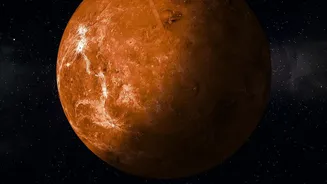
Venus is both strikingly similar to Earth and terrifyingly different. It shares a similar size, mass, and density with our home planet, leading scientists to believe it may have once been habitable, perhaps with its own oceans. Yet today, its surface
is hot enough to melt lead, and its atmosphere is over 90 times thicker than Earth's, composed mostly of carbon dioxide with thick clouds of sulphuric acid. This dramatic transformation is thought to be the result of a runaway greenhouse effect—a catastrophic climate change scenario. By studying Venus, scientists hope to better understand planetary evolution, the delicate balance that makes a world habitable, and the powerful forces that can change a planet’s climate. Shukrayaan represents a major step for India in contributing to these global scientific questions.
The Toolkit for a Toxic World
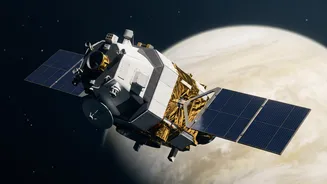
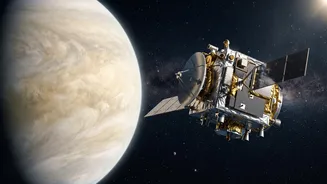
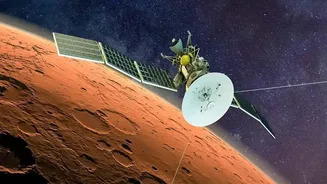
To study a planet as hostile as Venus, you need a specialized set of tools. Shukrayaan, formally the Venus Orbiter Mission, will carry nearly 100 kilograms of scientific instruments designed to peer through the planet's opaque atmosphere and map its surface. The mission’s payload includes contributions from India as well as international partners, including France, Russia, Sweden, and Germany, making it a collaborative global effort. These instruments work across different wavelengths—from radar to infrared to ultraviolet—to capture a comprehensive picture of Venus. The spacecraft, scheduled for a 2028 launch, will enter a highly elliptical orbit, eventually using a technique called aerobraking to settle into a closer path for its multi-year scientific investigation.
Piercing the Clouds with Radar
The star instrument of the mission is a high-resolution Synthetic Aperture Radar (SAR). Unlike optical cameras, radar can penetrate Venus's dense cloud cover, allowing scientists to map the surface geology regardless of day or night. This technology will create detailed topographical maps, searching for evidence of active volcanoes and other geological processes that have shaped the planet. The resolution is expected to be up to four times better than NASA's Magellan orbiter from the 1990s. In a first for any Venus mission, Shukrayaan will also carry a ground-penetrating radar, designed to study the planet's subsurface layers and give us a glimpse of its geological history.
‘Sniffing’ the Atmosphere for Clues
A key objective for Shukrayaan is to analyze the composition and dynamics of the Venusian atmosphere. To do this, it will carry a suite of spectrometers and sensors. One of these is the Venus Infrared Atmospheric Gases Linker (VIRAL), an instrument co-developed with France and Russia. VIRAL will study the chemistry of the atmosphere, looking for specific gas signatures that could reveal ongoing processes, such as volcanic outgassing. Another instrument, a mass spectrometer, will directly 'sniff' the particles in the upper atmosphere to identify their chemical makeup. Other sensors will look for lightning, which can provide clues about atmospheric dynamics, and analyze how the solar wind interacts with the planet's ionosphere.
Mapping Cloud Movements and Heat
Venus's atmosphere is in a state of constant, rapid motion, with winds that whip around the planet much faster than the planet itself rotates—a phenomenon known as super-rotation. Shukrayaan will carry instruments to study these extreme weather patterns. A dedicated cloud monitoring camera (VCMC) and a thermal camera will map the structure of the sulphuric acid clouds, track their movements, and measure temperature variations. By observing the atmosphere in different wavelengths, including ultraviolet and infrared, scientists can create a 3D map of its structure and dynamics. This data will be crucial for building better models of Venus's climate and understanding the forces driving its violent weather.